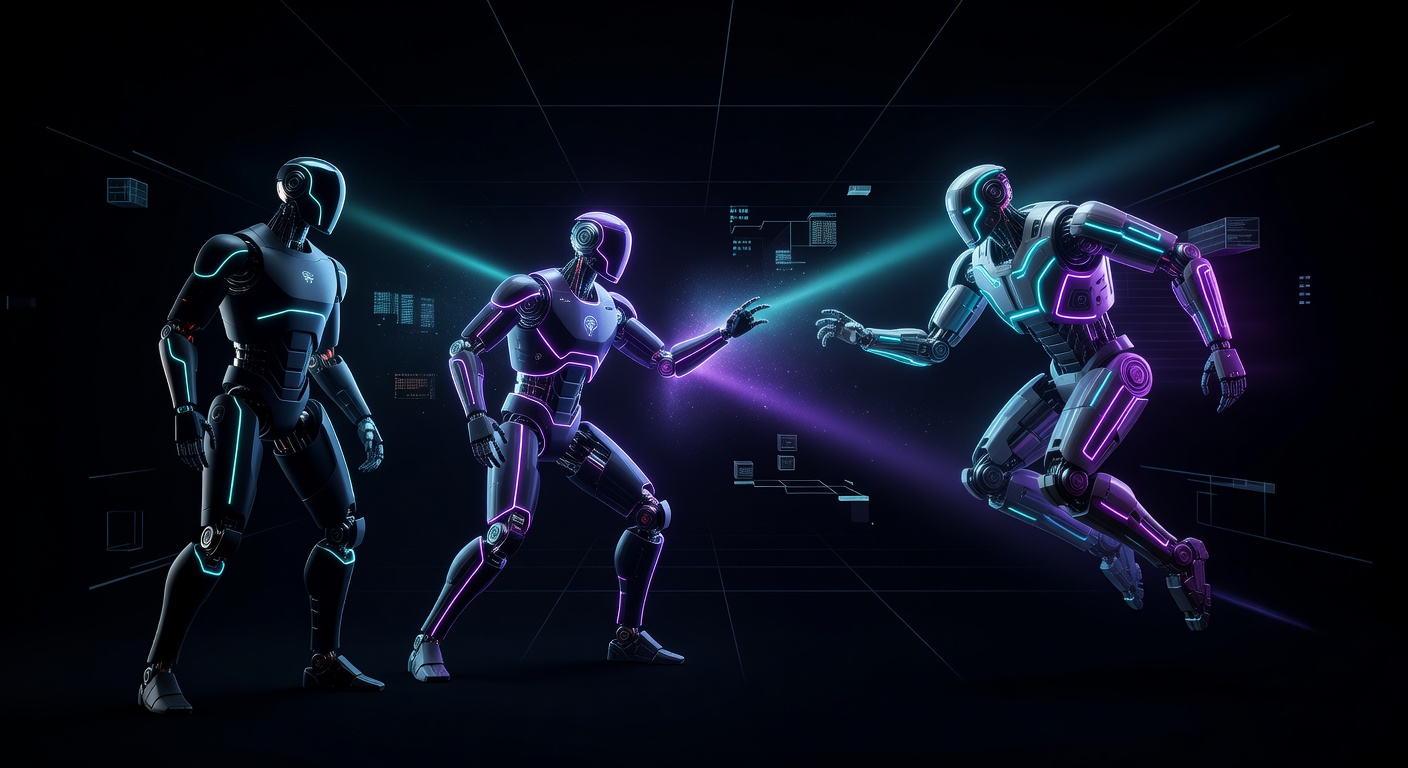
Three companies are spending billions to answer the same question: can humanoid robots do real work on a factory floor? After years of demo videos and staged presentations, 2026 is producing actual numbers. Robots are clocking shifts, handling parts, and generating data that shows exactly where they succeed and where they fall short.
The race between Tesla, Figure AI, and Boston Dynamics is not about who builds the best prototype. It is about who can manufacture humanoid robots at scale, deploy them in real production environments, and prove they deliver economic value. The stakes are enormous. The company that cracks this problem first will own a market projected to reach hundreds of billions within a decade.
Tesla Optimus: From Data Collection to Factory Floor
Tesla has deployed over 1,000 Optimus units across its global manufacturing facilities. The Gen 3 production line at the Fremont factory started turning out units in early 2026, and the company broke ground on a dedicated robot factory at Giga Texas with a target capacity of 10 million units per year.
That production target sounds outlandish until you understand Tesla’s strategy. Elon Musk has stated publicly that Optimus is meant to cost between $20,000 and $30,000 per unit, making it cheaper than a new car. At that price point, the addressable market extends far beyond factories into warehouses, agriculture, construction, and eventually homes.
The current reality is more modest. On the Q4 2025 earnings call, Musk acknowledged that deployed Optimus units are primarily doing learning and data collection rather than productive work. The robots handle autonomous parts processing, but their tasks are constrained and closely monitored. Tesla’s approach mirrors its Full Self-Driving strategy: deploy hardware early, collect massive amounts of real-world data, and iterate the AI until it catches up.
Tesla plans to produce 50,000 Optimus units in 2026. The company’s manufacturing expertise gives it a genuine advantage in the production scaling challenge. Building robots shares DNA with building cars: supply chain management, assembly line optimization, and quality control at volume. No other humanoid robot company has this institutional knowledge.
Figure AI: Proven Results at BMW
While Tesla talks about future production numbers, Figure AI has the strongest real-world deployment track record. An 11-month pilot at BMW’s Spartanburg, South Carolina plant helped build more than 30,000 X3 vehicles. Figure’s robots loaded over 90,000 parts across 1,250 operational hours.
Those numbers matter because they come from a demanding production environment. BMW’s assembly lines run on tight cycle times with zero tolerance for defects. A robot that can survive in that setting has crossed a threshold that most humanoid platforms have not reached.
Figure’s dedicated BotQ factory targets annual production of 12,000 units. The company raised $675 million at a $2.6 billion valuation in early 2024 and has continued securing funding as deployment results validated its approach.
The BMW deployment revealed important constraints. Figure’s robots performed well on repetitive material handling tasks but required human oversight for anything involving judgment calls. Inserting parts that need precise alignment, adapting to unexpected obstructions, and recovering from errors still require human intervention. The technology works for a defined set of tasks, not for general-purpose factory work.
Boston Dynamics Atlas: The Hyundai Bet
Boston Dynamics retired its hydraulic Atlas and launched an all-electric commercial version that debuted at CES 2026. The new Atlas is designed from the ground up as an enterprise-grade industrial robot, not a research platform.
Hyundai, which owns Boston Dynamics, is backing the deployment with serious money. A $26 billion investment in US manufacturing includes a robotics factory capable of producing 30,000 Atlas units per year. The first commercial deployments will target Hyundai Motor Group’s own manufacturing facilities through the Robot Metaplant Application Center.
Boston Dynamics brings 30 years of robotics engineering experience to the competition. Atlas has the most sophisticated locomotion and manipulation capabilities among commercial humanoid robots. Its ability to work through unstructured environments, recover from falls, and handle heavy objects exceeds what Tesla and Figure have demonstrated.
The trade-off is cost. Atlas is an expensive machine built to industrial specifications. Boston Dynamics has not publicly disclosed pricing, but analysts estimate each unit will cost significantly more than Tesla’s target price. The company is betting that reliability and capability justify a premium, particularly for customers who cannot afford downtime.
The Chinese Factor
Western companies are not competing in isolation. Chinese robotics firms are moving fast and benefiting from government support, lower manufacturing costs, and a massive domestic market.
Unitree Robotics sells its G1 humanoid for under $16,000, undercutting every Western competitor. The robot is simpler than Atlas or Optimus, but its price point makes it accessible to small manufacturers and research labs that cannot justify six-figure investments.
UBTECH, Fourier Intelligence, and Agibot are all scaling production. China’s humanoid robot shipments grew faster than any other region in 2025, and the gap is widening. Government subsidies, streamlined regulations, and integration with Chinese manufacturing supply chains give these companies structural advantages that Western firms will struggle to match on cost alone.
The Operational Ceiling Problem
Every humanoid robot platform shares the same fundamental challenge: they cannot work long enough. Most current systems hit an operational ceiling of three to four hours before batteries need recharging or systems need resetting.
A factory runs two or three shifts per day. A robot that works four hours and needs an hour to recharge covers less than half of a single shift. Until battery technology and thermal management improve, humanoid robots will supplement human workers rather than replace them.
Dexterity remains another unsolved problem. Picking up a 20-kilogram box is straightforward. Threading a wire use through a narrow channel is not. Human hands have 27 degrees of freedom and decades of motor learning. Current robot hands have fewer degrees of freedom and limited tactile feedback. Tasks requiring fine manipulation remain firmly in the human domain.
Reliability standards add another barrier. Industrial robots like those from FANUC and ABB run for tens of thousands of hours between failures. Humanoid robots are nowhere near that benchmark. A robot that fails once per shift creates disruptions that erase whatever productivity gains it provides.
What the Economics Look Like
At Tesla’s target price of $25,000 per unit, the math works if the robot can replace even half a shift of human labor. A factory worker in the United States costs roughly $50,000 to $70,000 per year in wages and benefits. A robot that handles four hours of work per day pays for itself within a year.
At Boston Dynamics pricing, the payback period extends to multiple years. But for hazardous environments, clean rooms, or tasks that cause repetitive strain injuries, the economic calculation changes. Avoiding a single workplace injury lawsuit can justify the cost of several robots.
The subscription model is gaining traction. Instead of buying robots outright, factories lease them with maintenance and software updates included. Figure and Apptronik both offer Robotics-as-a-Service pricing that lowers the upfront commitment and shifts risk to the robot maker.
Safety and Standards
The International Federation of Robotics identified safety standards as a top priority for 2026. Humanoid robots working alongside humans need certified safety systems that go beyond what traditional industrial robots require.
Traditional robots operate in cages, separated from humans. Humanoid robots are designed to share workspace with people. This requires real-time collision avoidance, force limiting on contact, and fail-safe behaviors when sensors degrade or communication links drop.
No universal safety standard for humanoid robots exists yet. ISO 10218 covers traditional industrial robots, and ISO/TS 15066 addresses collaborative robots, but neither was designed for bipedal machines that walk through shared spaces. New standards are under development, but finalization is likely two to three years away.
Where This Goes
Global humanoid robot shipments topped 13,000 units in 2025. Industry forecasts project that number to multiply several times over by 2028, driven by falling unit costs and proven factory deployments.
The near-term winners will be companies that focus on specific, well-defined tasks rather than general-purpose capabilities. Material handling, machine tending, and quality inspection are the beachhead applications where humanoid form factors offer advantages over wheeled or fixed-arm alternatives.
The competition between Tesla, Figure, and Boston Dynamics will produce rapid improvement. Each company brings different strengths: Tesla has manufacturing scale, Figure has deployment data, and Boston Dynamics has engineering depth. The winner may not be the company with the best robot but the one that solves the production and reliability problems fastest.
Factory managers watching this race are not waiting for a clear winner. They are running pilots with multiple vendors, collecting their own performance data, and preparing their facilities for a workforce that includes both humans and machines. The question is no longer whether humanoid robots will work in factories. It is how soon they will work well enough to justify replacing the help-wanted sign with a purchase order.
📚 You May Also Like
Gyucheol Choi
Senior Data Scientist · ImpriMed Korea
AI researcher specializing in precision medicine and drug sensitivity analysis. Covers AI tools, healthcare AI, and emerging tech with hands-on expertise.
Leave a Reply