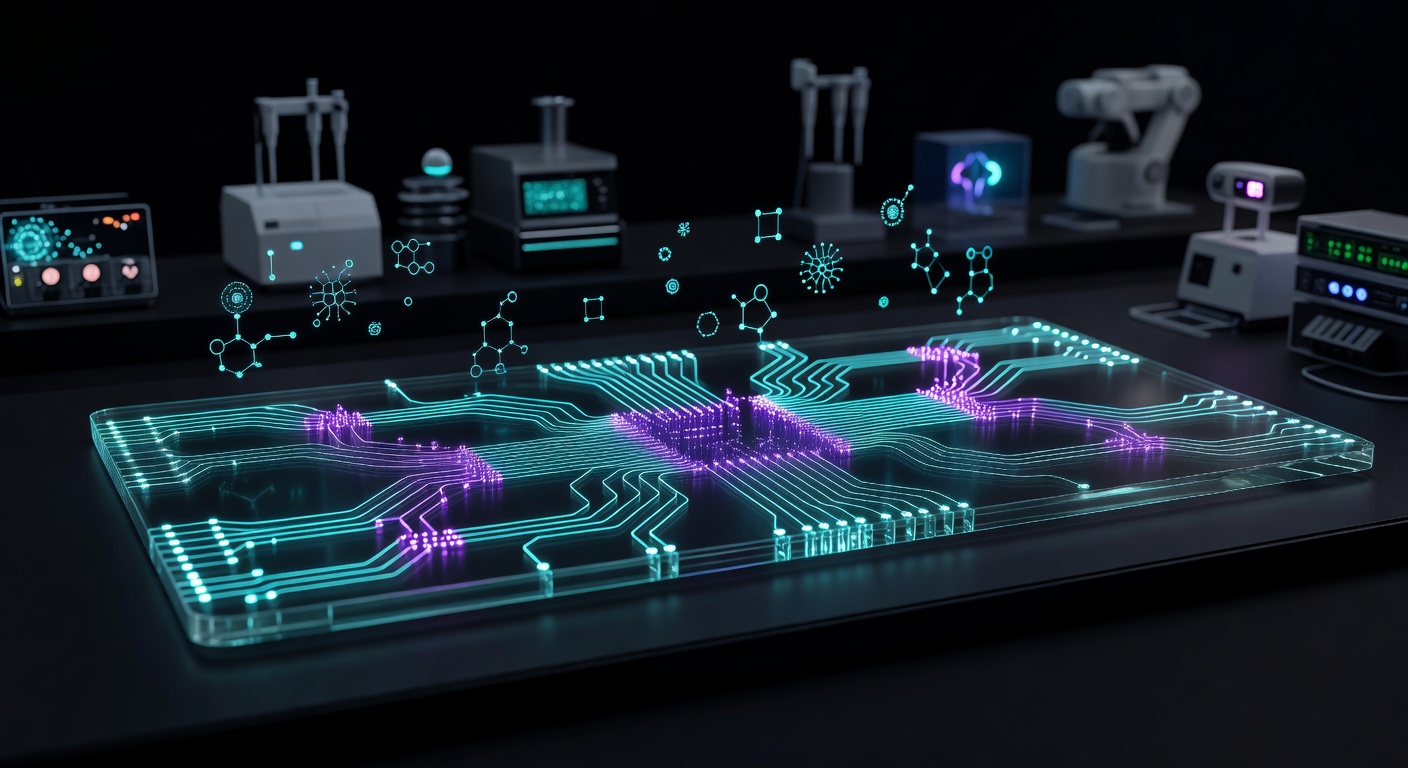
A child diagnosed with T-cell acute lymphoblastic leukemia used to wait days or weeks for drug sensitivity results. Researchers at the University of Utah’s Huntsman Cancer Institute just cut that to under four hours. Their microfluidic device, called μPharma, uses machine learning to predict which targeted therapies will work against a patient’s cancer cells — without ever exposing those cells to the drugs directly.
Published in Med in March 2026, the study showed μPharma accurately predicted responses to dasatinib and venetoclax, two therapies under investigation for T-ALL. The device also uncovered a previously unknown link between drug response and a key molecular marker in this cancer type.
This is not an isolated breakthrough. AI-integrated microfluidics — often called lab-on-a-chip technology — is reshaping how drugs get screened, tested, and matched to patients. Here is where things stand in 2026.
What Is a Lab-on-a-Chip?
A lab-on-a-chip (LoC) compresses laboratory functions onto a single chip, typically the size of a credit card. Tiny channels move fluid samples through different processing stages: mixing, separation, detection, analysis. The core technology is microfluidics — the science of manipulating fluids at the microliter or nanoliter scale.
These devices have existed for decades, but recent AI integration has turned them from specialized research tools into platforms capable of high-throughput drug screening with minimal human input.
How μPharma Works
The μPharma platform uses digital microfluidics to move tiny droplets across the chip surface. This automates the labor-intensive liquid-handling steps that would normally require trained technicians and expensive equipment.
The process works in three stages:
- Cell preparation: Patient cancer cells are loaded onto the chip. The microfluidic system handles staining and preparation automatically, making key molecules linked to drug susceptibility visible inside the cells.
- Imaging: High-resolution microscopy captures molecular markers, their locations within cells, and cell morphology.
- AI prediction: A machine learning model analyzes these images to predict which drugs the cancer cells will respond to — all without directly treating the cells with those drugs.
The entire workflow finishes in under four hours. Traditional drug sensitivity assays often require culturing cells for several days and testing multiple drug concentrations, a process that can take a week or more.
Why This Matters for Pediatric Cancer
Pediatric cancers like T-ALL demand fast decisions. Children’s bodies respond differently to chemotherapy than adults, and aggressive cancers can progress quickly during diagnostic delays. A platform that delivers drug-response profiles on the same day as a biopsy could fundamentally change treatment timelines.
The μPharma study, conducted in collaboration with St. Jude Children’s Research Hospital, demonstrated that the AI model’s predictions aligned with actual drug sensitivity measurements. Researchers noted the platform could reduce unnecessary treatments and their associated side effects by quickly narrowing down effective options.
The technology is not yet used in clinical settings, but the proof-of-concept results are strong enough that clinical validation studies are being planned.
Organ-on-a-Chip: Scaling the Concept
While μPharma focuses on single-cell drug prediction, a related technology called organ-on-a-chip takes microfluidics further. These devices simulate entire organ systems — liver, lung, kidney, heart — on interconnected chip networks. Cells from different organs grow in separate chambers connected by microfluidic channels that mimic blood flow.
This lets researchers study how a drug affects multiple organs simultaneously. A cancer drug might kill tumor cells effectively but damage the liver — organ-on-a-chip systems can flag that toxicity before the drug reaches human trials.
Emulate, a company spun out of Harvard’s Wyss Institute, has pushed its Liver-Chip through multiple rounds of FDA review under the ISTAND (Innovative Science and Technology Approaches for New Drugs) program. The chip is approaching regulatory approval for use in drug safety assessments, pending validation by two independent commercial users.
Meanwhile, the AVA workstation — the first self-contained organ-on-a-chip platform — now supports up to 96 chip emulations in a single run, bringing costs down and throughput up.
The FDA’s Push Away From Animal Testing
These developments arrive at a critical regulatory moment. The FDA announced plans to phase out animal-testing requirements for drug assessments, citing advances in what it calls new approach methodologies (NAMs). These include organ-on-a-chip devices, organoids, computational PK/PD modeling, and AI-driven analysis.
The FDA Modernization Act 2.0, signed into law in 2022, already removed the requirement that drugs be tested on animals before human trials. But adoption has been slow because regulators needed proof that alternatives produce reliable results. The μPharma study and Emulate’s Liver-Chip progress are exactly the kind of validation the FDA has been waiting for.
For the pharmaceutical industry, this shift could save billions. Animal studies are expensive, slow, and notoriously poor at predicting human responses — roughly 90% of drugs that pass animal testing still fail in human clinical trials.
AI’s Role in Making Chips Smarter
The real acceleration in lab-on-a-chip technology comes from AI integration at every stage:
- Design optimization: Machine learning models now design chip layouts and channel geometries, reducing the trial-and-error of traditional microfluidic engineering.
- Automated experiment control: AI systems manage fluid flow rates, temperature, and timing in real-time, adapting protocols based on what the sensors detect.
- Pattern recognition: Deep learning models identify drug-response patterns from cell imaging data that human analysts would miss or take much longer to find.
- Predictive modeling: Instead of testing every drug-dose combination, AI predicts outcomes from limited data, dramatically reducing the number of experiments needed.
A January 2026 review in ACS Applied Materials & Interfaces described this convergence as enabling “phenotypic drug discovery at unprecedented speed and scale” — identifying drug candidates based on observable cell behavior rather than targeting specific molecular pathways.
What Comes Next
Several developments are converging to push lab-on-a-chip from research curiosity to clinical tool:
- Multi-organ chips connecting 10+ organ models on a single platform are in development at multiple academic centers, creating “body-on-a-chip” systems for whole-body drug response modeling.
- Point-of-care deployment: Smaller, cheaper chips designed for use in hospitals and clinics — not just research labs — are entering pilot programs.
- Integration with AI biomarker discovery could let chips identify new drug targets while simultaneously screening existing compounds.
- Personalized medicine at scale: As chip costs drop, running individual patient samples through drug screening panels becomes economically viable for routine cancer care.
The μPharma team at Utah has already outlined plans to expand their platform beyond T-ALL to other blood cancers, including acute myeloid leukemia and multiple myeloma. If the clinical validation studies succeed, same-day drug sensitivity testing could become standard practice in pediatric oncology within the next few years.
The Bigger Picture
Lab-on-a-chip technology sits at the intersection of several trends we have covered: AI-driven drug development, companion diagnostics, and the broader push toward precision medicine. What makes this moment different is that the technology is finally producing clinical-grade results fast enough to influence real treatment decisions.
When a four-hour test can tell oncologists which drugs will work for a specific patient’s cancer, the gap between diagnosis and effective treatment narrows to almost nothing. That is not a future promise — it is a 2026 proof of concept waiting for its first clinical trial.
📚 You May Also Like
Gyucheol Choi
Senior Data Scientist · ImpriMed Korea
AI researcher specializing in precision medicine and drug sensitivity analysis. Covers AI tools, healthcare AI, and emerging tech with hands-on expertise.
Leave a Reply