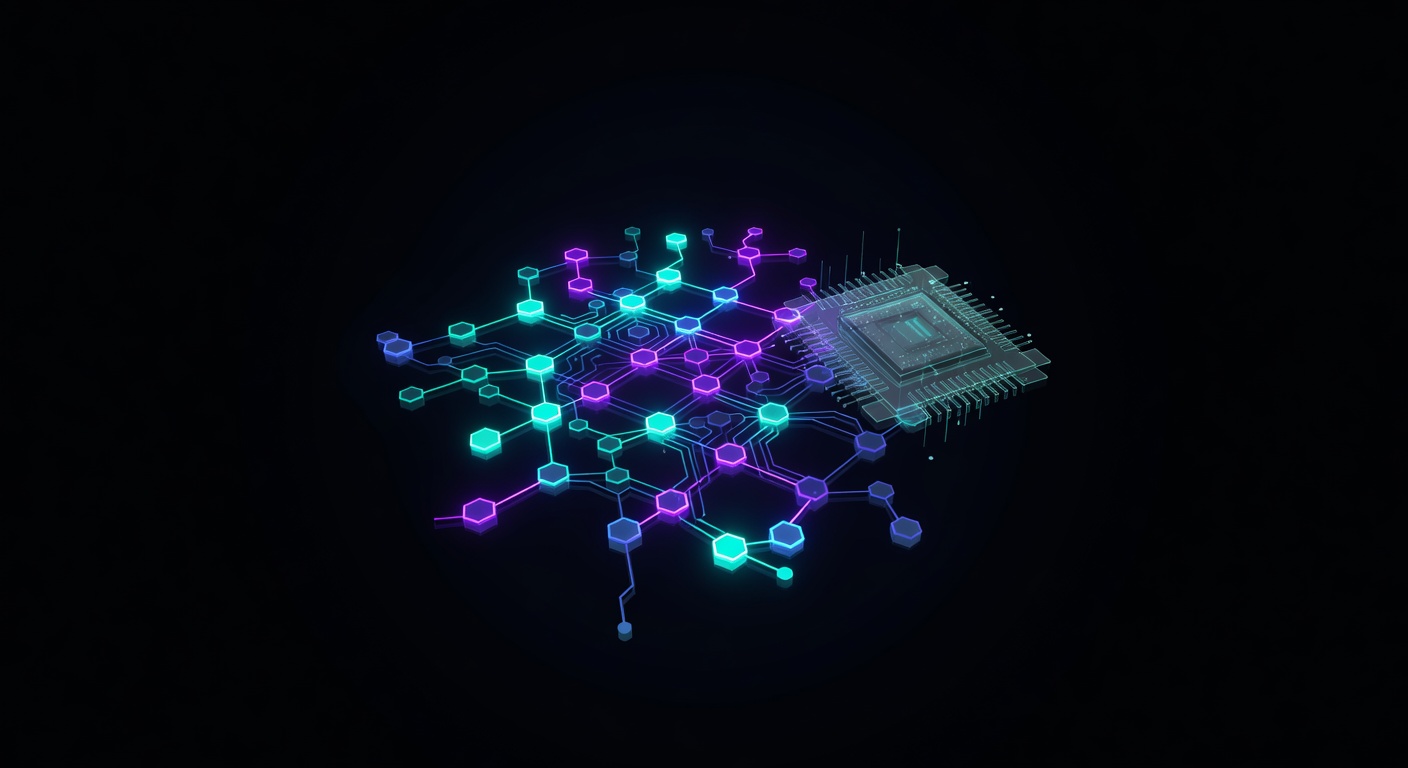
For more than a decade, neuromorphic computing was a research curiosity. Universities wrote papers about brain-inspired silicon; a few chipmakers built demonstration boards; enterprises politely declined to buy them. The economics of AI ran on GPUs, full stop. That consensus is cracking in 2026, and the cracks have specific names: Loihi 3, NorthPole, and Akida 2.
Neuromorphic chips have spent 2025 and early 2026 transitioning from academic benchmarks to commercial silicon with real design wins. The power-efficiency numbers are the reason. For narrow AI inference workloads — the kind that dominate edge devices, defense sensors, and always-on consumer hardware — brain-inspired chips are now delivering 25x to 70x better joules-per-inference than contemporary high-end GPUs. That is not a rounding error. It is a structural shift in how inference gets priced.
What Makes a Chip Neuromorphic
A conventional GPU runs dense matrix multiplications across thousands of cores, with data shuttled back and forth through a hierarchical memory system. That architecture is brilliant for training deep networks, which is exactly why Nvidia built an empire on it. But inference — especially sparse, event-driven, sensor-fed inference — does not need dense matrix math. A camera feed, a microphone stream, and a LIDAR point cloud are mostly empty most of the time; a GPU still grinds through them at full power.
Neuromorphic chips throw out that assumption. They are built around spiking neural networks, which only fire when an input event crosses a threshold, and they co-locate memory with compute so that weights never move. The result is a silicon pattern that looks much more like a brain than a calculator: millions of small, asynchronous cores that consume almost no power when idle and burst into activity only when signals warrant it.
Three design principles make the whole approach work. First, event-driven computation means clocks are replaced by asynchronous spikes. Second, in-memory computation eliminates the von Neumann bottleneck that dominates GPU energy budgets. Third, massive parallelism — often on the order of millions of simple cores — means that workloads scale naturally without the thermal problems of dense accelerator arrays.
Intel Loihi 3: The Mainstream Moment
Intel’s Loihi line spent years as a research-only platform, accessible through academic partnerships but never really for sale. Loihi 3, released commercially in January 2026, changes the posture entirely. Fabricated on a 4-nanometer process, it packs 8 million digital neurons and 64 billion synapses onto a single chip. Peak power draw under full workload is roughly 1.2 watts — a number that is almost hard to parse if you come from the GPU world, where high-end accelerators burn 700 to 1,200 watts.
What makes Loihi 3 commercially interesting is not just the silicon but the software. Intel has paid attention to the lesson that killed many previous non-GPU accelerators: a chip without mature tooling is a chip no one uses. The current Lava software stack integrates with PyTorch for model conversion, supports standard spiking-network libraries, and ships with reference designs for gesture recognition, anomaly detection, and sensor fusion. Several robotics vendors and defense primes now cite Loihi 3 as a baseline inference platform in public specifications.
The market Intel is targeting is clear: edge inference workloads where battery life or thermal budget kills a GPU. Drones, wearables, industrial sensors, autonomous mobile robots, and any surveillance platform that must run always-on vision for days on a small battery. Those markets are collectively large, currently underserved by GPUs, and exactly where neuromorphic architectures shine.
IBM NorthPole: The Inference Efficiency Champion
IBM’s NorthPole architecture took a different path. Where Loihi emphasizes research flexibility, NorthPole is optimized ruthlessly for one thing: inference on fixed neural networks, as fast and as efficiently as possible. The result is not a spiking chip in the classical sense but a distributed compute-memory fabric that looks neuromorphic in the ways that matter for energy.
NorthPole moved into full production in late 2025, and the benchmarks that followed are startling. For image-recognition workloads, IBM reports roughly 25x higher energy efficiency than leading GPUs. For large language model inference — the workload everyone cares about — the figure jumps to 72.7x better joules-per-token in comparable throughput regimes. IBM has concentrated its rollout on vision-heavy enterprise and defense applications where latency, determinism, and power budget all matter simultaneously.
Deployment is still narrower than GPUs, because NorthPole requires models to be compiled and pinned to the fabric rather than dynamically loaded. But for fixed-workload inference at scale — think security cameras, radar processing, document scanning, and speech transcription farms — the efficiency numbers are rewriting the total-cost-of-ownership calculation.
BrainChip Akida 2: Neuromorphic Finds Its Niche
The third player worth watching is BrainChip, the Australian startup that has spent years chasing commercial neuromorphic silicon. Akida 2 is now shipping to several embedded-systems customers. It is not as powerful as Loihi 3 or as efficient as NorthPole, but it is small, cheap, and IP-licensable — which means it shows up not as a standalone chip but as a block inside larger SoCs. That distribution model matters. It is how BrainChip plans to get neuromorphic inside smart-home cameras, wearables, hearing aids, and automotive driver-monitoring systems without asking OEMs to redesign their boards.
Akida’s real contribution is proving that the neuromorphic approach is not limited to hyperscaler use cases. If the technology works at the IP-block level, it can propagate into hundreds of consumer devices without a single big-bang moment.
The Training Gap: Why Neuromorphic Models Are Still Hard to Build
The biggest remaining obstacle is not silicon but software. Spiking neural networks do not train the way conventional deep networks do. Backpropagation, the workhorse algorithm that underpins every major AI model since 2012, does not map cleanly to spike-based computation because spike events are non-differentiable. Researchers have worked around this with surrogate gradients, pretrained dense-to-spike conversion, and hybrid training loops, but each approach has accuracy tradeoffs.
That means most production neuromorphic workloads today are derived from a conventionally trained model that is then compiled, quantized, and converted into a spiking representation. The conversion step sometimes costs two or three percentage points of accuracy, which is fine for many edge use cases but problematic for anything safety-critical. Expect training-tool maturity to be the single biggest predictor of whether neuromorphic adoption accelerates or stalls in 2027.
Where GPUs Still Win
None of this spells the end of the GPU. Training large models remains a job for dense matrix accelerators, and that workload is not going anywhere — if anything, it is expanding as AI’s power demands reshape the electric grid. Neuromorphic chips are still terrible at training. Spiking networks are harder to train than dense networks, and the best results still require dense-network pretraining followed by conversion — which means a GPU cluster somewhere in the loop.
The division of labor that is emerging looks like this: GPUs train, neuromorphic chips infer at the edge, and conventional CPUs orchestrate. That is not a zero-sum outcome for Nvidia, AMD, or any of the training-focused silicon vendors. It is a new market layer beneath them, one that mostly did not exist as a commercial category until this year.
It also aligns with where most AI inference now runs: on device, close to the sensor, without round-tripping to a datacenter. Neuromorphic silicon is simply the most energy-efficient way to execute that pattern.
The Adoption Playbook
Three customer segments are driving early volume, and each one has a different buying logic.
Defense and aerospace. Power budgets on satellites, drones, and handheld systems are unforgiving, and the defense industry has the patience to integrate non-standard silicon. Loihi 3 and NorthPole have both landed public design wins in this segment in 2026.
Industrial sensing and robotics. Factories running continuous quality-control cameras or predictive-maintenance sensors care about watts as directly as dollars. Neuromorphic inference on-device eliminates expensive uplink bandwidth and cuts cooling costs.
Consumer edge. AR glasses, hearing aids, and always-listening smart devices cannot tolerate a GPU’s thermal profile. The first mainstream consumer neuromorphic deployments — through Akida IP blocks embedded in SoCs — are likely to ship to consumers in late 2026 and 2027.
What to Watch in the Next 18 Months
Three signals will tell you whether neuromorphic computing is on track to become a standard infrastructure category or stay niche.
First, watch whether one of the top three cloud providers announces a neuromorphic-powered inference tier. That would force competitive responses and lock in developer mindshare. Second, watch whether an AR glasses platform — Meta’s next-generation Orion, Apple’s follow-up to Vision Pro, or one of the Chinese contenders — ships neuromorphic silicon as its vision coprocessor. That single design win would establish the consumer beachhead. Third, watch whether benchmark organizations publish standardized neuromorphic inference suites. Without them, buyers cannot compare chips, and the market stays balkanized.
The deeper story is that for the first time since the GPU became synonymous with AI, there is a credible alternative architecture with shipping silicon, working software, and real design wins. That does not guarantee neuromorphic dominance — plenty of promising accelerator architectures have failed to cross the chasm — but it means 2026 is the year the conversation about AI inference stops being a conversation about GPUs alone.
📚 You May Also Like
Gyucheol Choi
Senior Data Scientist · ImpriMed Korea
AI researcher specializing in precision medicine and drug sensitivity analysis. Covers AI tools, healthcare AI, and emerging tech with hands-on expertise.
Leave a Reply