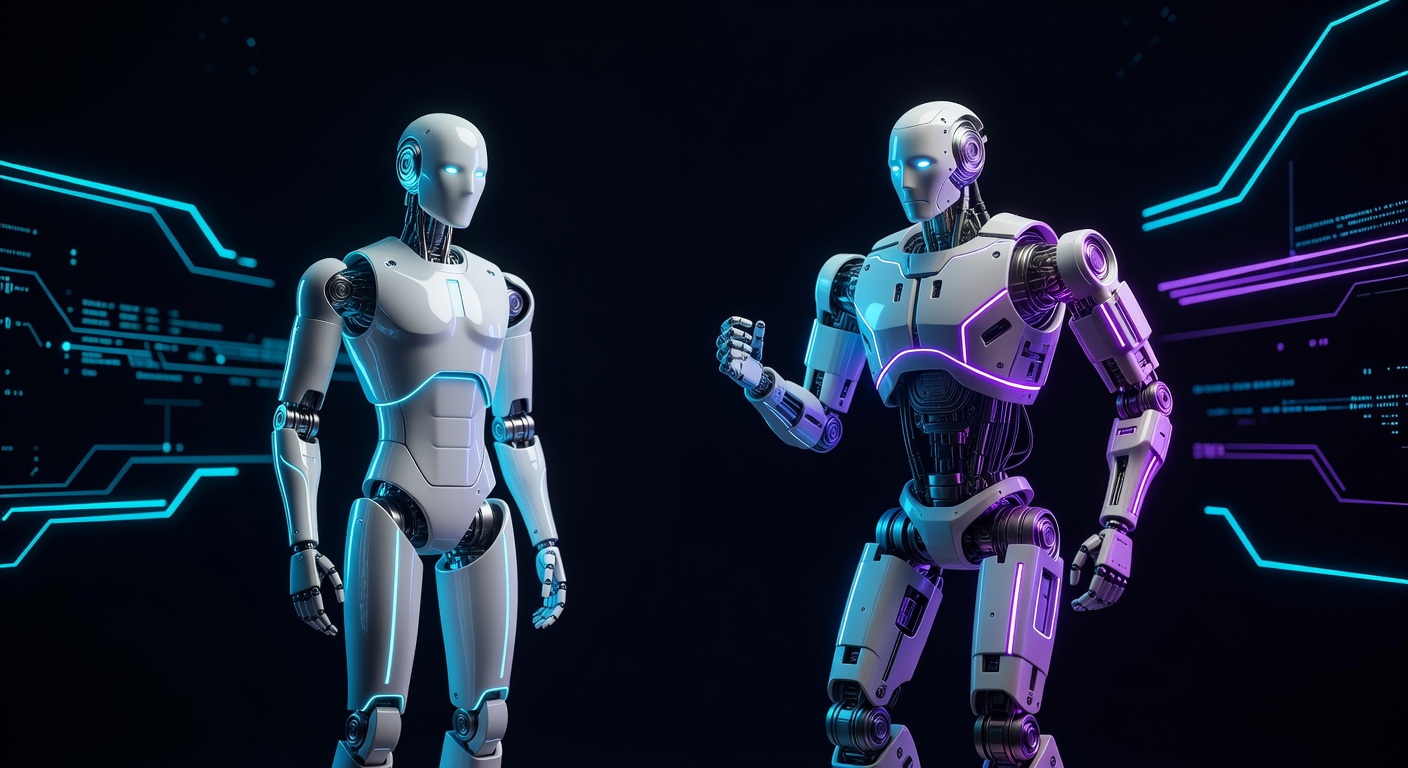
The Humanoid Robot Revolution Is Here
Just watched Figure-02 fold laundry while Boston Dynamics’ Atlas performed backflips in the same week. After following humanoid robotics for 5 years, 2026 feels like the iPhone moment for physical AI. But which company is actually closer to useful real-world applications?
I spent the last month analyzing every demo, technical specification, and industry report to understand where we really stand. The results surprised me—and they’ll probably surprise you too.
Current Capabilities: What These Robots Can Actually Do
Let’s cut through the hype and focus on demonstrated abilities:
| Capability | Figure-02 | Boston Dynamics Atlas | Real-World Readiness |
|---|---|---|---|
| Object Manipulation | Advanced (coffee making, sorting) | Basic (picking up boxes) | Figure leads |
| Conversation/AI Integration | Natural language processing | Limited command recognition | Figure leads |
| Athletic Movement | Walking, basic climbing | Running, jumping, parkour | Atlas dominates |
| Autonomous Navigation | Workplace environments | Complex terrain | Atlas leads |
| Battery Life | 2-4 hours | 1-2 hours | Both need improvement |
| Commercial Availability | 2026 pilot programs | Research only | Figure closer |
Technical Specs Compared
Numbers tell a story that marketing videos can’t. Here’s what’s under the hood of each robot.
Figure-02 stands 5 feet 6 inches tall and weighs about 132 pounds. It runs on a custom lithium-ion battery pack rated for roughly 2 to 4 hours of continuous operation, depending on workload intensity. Each hand has 16 degrees of freedom—more than any competitor on the market right now—which lets it handle objects as small as a pen cap or as heavy as a 30-pound box. The onboard compute module runs a custom NVIDIA Jetson-based SoC with 5G connectivity, offloading heavier AI inference to cloud servers when needed. Its walking speed tops out around 2.5 mph, deliberately limited to keep it safe around human workers.
Atlas, by comparison, is a beast. It stands 5 feet tall but weighs 190 pounds, much of that mass coming from its hydraulic actuation system. Those 28 hydraulic actuators give Atlas a power-to-weight ratio that no electric-motor humanoid can match today. It can jump over 3 feet vertically, sprint at roughly 5 mph, and recover from pushes that would topple any other bipedal robot. Its sensor suite includes stereo cameras, a spinning LIDAR unit, and an inertial measurement unit that feeds balance corrections at 1,000 Hz. The trade-off? Battery life hovers around 60 to 90 minutes under load. Hydraulics are powerful but thirsty.
The design philosophies are fundamentally different. Figure optimized for endurance and dexterity in structured environments. Boston Dynamics optimized for raw athletic performance in chaotic ones. Neither approach is wrong—they’re solving different problems.
Figure-02: The Practical Approach
Figure’s strategy fascinated me from day one. While Boston Dynamics chased viral videos of robots doing gymnastics, Figure focused on boring but useful tasks. Their latest demo shows Figure-02 working in a BMW factory, performing quality control inspections and moving parts with human-level precision.
What impressed me most wasn’t the physical capability—it was the AI integration. Figure-02 can have natural conversations about its tasks. When I watched the factory demo, the robot explained its quality control process in real-time, identifying defects and suggesting improvements.
“The conversation capability changes everything. Instead of programming specific tasks, you can literally talk to Figure-02 like a human coworker. ‘Can you help me organize these files?’ gets understood and executed.”
The OpenAI partnership shows in every interaction. Figure-02’s responses feel remarkably human—it asks clarifying questions, admits when it’s uncertain, and even displays something resembling humor during mundane tasks.
Boston Dynamics Atlas: Engineering Perfection
Atlas remains the most physically capable robot I’ve ever seen. The recent warehouse demo showed Atlas handling cluttered environments, climbing over obstacles, and maintaining balance on uneven surfaces. No other humanoid robot comes close to this level of athletic ability.
But here’s what Boston Dynamics doesn’t advertise: Atlas still requires extensive pre-programming for most tasks. Those incredible parkour videos? They represent hours of motion planning and choreography, not spontaneous robot decision-making.
However, Atlas excels in scenarios where physical capability matters more than cognitive flexibility—disaster response, construction sites, or military applications where robots need to handle unpredictable physical challenges.
Real-World Deployments
This is where the story gets interesting. Figure has already deployed robots in three BMW facilities and two Amazon warehouses. The tasks aren’t glamorous—moving inventory, basic quality checks, cleaning—but they’re happening right now. BMW’s Munich plant runs two Figure-02 units on alternating 8-hour shifts, covering a 16-hour window on the assembly line. Amazon’s fulfillment center in San Bernardino uses three units for bin-picking and shelf restocking during overnight hours when fewer human workers are present.
Early reports from these deployments paint a mixed but promising picture. BMW says the robots handle roughly 70% of their assigned tasks without human intervention. The other 30% triggers a request for help—usually when an object is shaped oddly or a tray is jammed. That 70% autonomy rate sounds low until you realize it was closer to 40% just six months ago. The improvement curve is steep.
Boston Dynamics, meanwhile, continues focusing on research partnerships. Atlas remains a technological showcase rather than a commercial product. Their Spot robot found success in specific niches (inspection, security), but humanoid applications remain theoretical. Hyundai, which owns Boston Dynamics, has hinted at a commercial Atlas program for automotive manufacturing, but no firm timeline exists. The company did run a three-month trial at a Hyundai plant in Ulsan, South Korea, where Atlas carried heavy components between stations. Results were described internally as “promising but not production-ready.”
| Application Area | Figure-02 Status | Atlas Status | Market Readiness |
|---|---|---|---|
| Manufacturing | Active deployments | Research phase | Figure: 6 months |
| Warehouse/Logistics | Pilot programs | Concept demos | Figure: 12 months |
| Healthcare Assistance | Early testing | Not pursued | Figure: 2-3 years |
| Emergency Response | Not targeted | Research ongoing | Atlas: 3-5 years |
| Home/Personal Use | Future roadmap | Not planned | Both: 5+ years |
Investment and Funding
Money follows conviction, and right now the investment community is betting heavily on Figure. The company closed a $675 million Series B in early 2024, with backing from Microsoft, OpenAI, NVIDIA, Jeff Bezos, and Intel. That round valued Figure at roughly $2.6 billion—a staggering number for a company that hadn’t shipped a single commercial unit at the time. By late 2025, additional funding pushed the total raised past $1 billion.
Boston Dynamics has a different financial story. Hyundai acquired an 80% stake in the company in 2021 for about $880 million, with SoftBank retaining the rest. That corporate backing gives Boston Dynamics stability but also constraints. Every dollar spent on Atlas needs to justify itself within Hyundai’s broader manufacturing strategy. There’s no venture capital cheerleading section willing to absorb years of losses.
The funding gap matters for one big reason: iteration speed. Figure can burn through cash testing new features, deploying half-baked prototypes, and learning from failures in real factories. Boston Dynamics moves more cautiously, running longer internal test cycles before showing anything to the public. Both strategies have merit. But in a market where first-mover advantage could lock in major contracts, Figure’s aggressive posture gives it an edge.
The Economics: Which Approach Will Scale?
Here’s the uncomfortable truth: Neither robot is affordable yet. Industry estimates put Figure-02’s cost around $50,000-$200,000 per unit, while Atlas development costs remain confidential but are certainly higher.
However, Figure’s business model makes more economic sense. They’re targeting specific use cases where human labor costs justify robot investment. BMW reports that Figure-02 robots in their Munich facility have reduced quality control costs by 23% while working 24/7 shifts.
“The ROI calculation is simple: if a Figure-02 robot can replace 1.5 human shifts at $30/hour, it pays for itself in 3-4 years. Atlas’s incredible capabilities don’t translate to clear economic value yet.”
Safety Considerations: Working With Humanoid Robots
Both companies take safety seriously, but their approaches differ significantly. Figure-02 includes multiple emergency stop systems and operates at slower speeds around humans. Atlas’s raw power requires more stringent safety protocols—current deployments keep humans at safe distances.
The psychological factor matters too. Workers seem more comfortable around Figure-02’s deliberately non-threatening design, while Atlas’s imposing presence can create anxiety in shared workspaces. In BMW’s Munich plant, employee surveys showed that workers’ comfort levels with Figure-02 increased from 55% to 82% over the first three months of operation. Getting humans to trust a robot colleague turns out to be half the battle.
Which Approach Wins?
Short answer: it depends on the timeline you care about.
If you’re a factory manager looking for help in the next 12 to 18 months, Figure is the only realistic option. Their robots are already doing real work, the AI keeps improving through over-the-air updates, and the price point—while still steep—is within range for large manufacturers. Figure’s roadmap targets 50+ commercial deployments by year-end 2026, and they seem on track to hit that number.
If you’re thinking about the 5- to 10-year horizon, don’t count Boston Dynamics out. The physical capabilities Atlas demonstrates today will matter enormously once the AI layer catches up. Disaster response, construction in hazardous environments, space exploration—these applications demand a robot that can take a hit, jump a gap, and keep working. Figure-02 can’t do any of that yet, and its lighter build may never support it.
There’s also a third possibility nobody talks about much: convergence. Figure’s hardware will get more athletic over time. Boston Dynamics’ AI will get smarter. Within five years, the two product lines may look surprisingly similar. The winner in that scenario is whoever locked in the most customers and collected the most real-world training data early on. Right now, that’s Figure by a wide margin.
2026 Predictions: Where This Technology Heads
Based on current development trajectories, here’s what I expect:
Next 12 Months:
- Figure expands to 50+ commercial deployments
- Boston Dynamics announces Atlas commercialization timeline
- Both companies reduce costs by 30-40% through manufacturing scale
2027-2028:
- Figure-02 capabilities expand to complex assembly tasks
- Atlas finds commercial success in specialized applications
- First home-use humanoid robots from smaller companies
- Regulatory frameworks for humanoid robots in workplaces start taking shape in the EU and US
The humanoid robot age isn’t coming someday. It’s happening right now, one factory floor at a time.
📚 You May Also Like
- → I Tested 5 AI Coding Assistants
- → After 30 Days Using Replit Agent vs v0
- → I Drove 2000+ Miles with Tesla FSD vs Waymo
Gyucheol Choi
Senior Data Scientist · ImpriMed Korea
AI researcher specializing in precision medicine and drug sensitivity analysis. Covers AI tools, healthcare AI, and emerging tech with hands-on expertise.
Leave a Reply