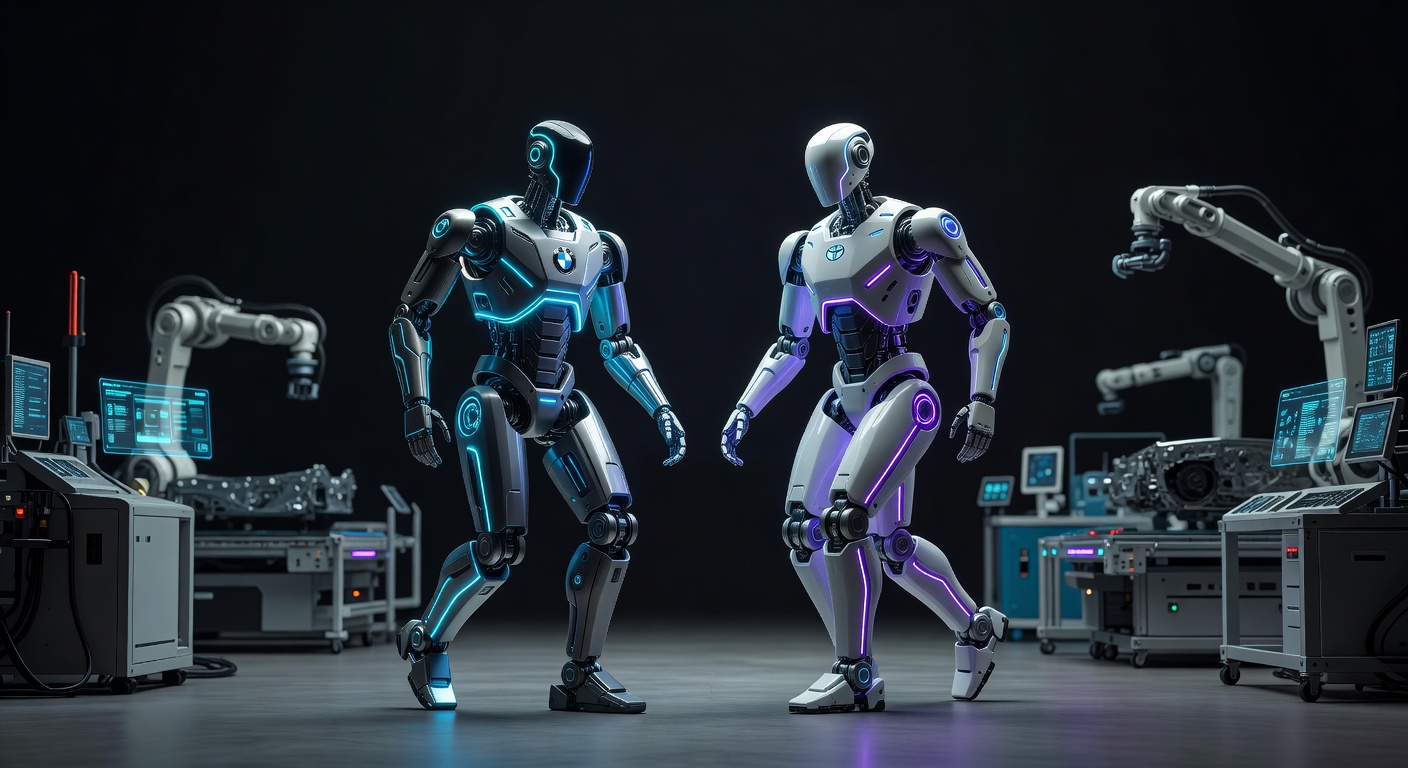
Humanoid Robots Just Stopped Being a Demo
For most of the last decade, humanoid robots have lived in the same uncomfortable space as autonomous trucks and quantum computers: technically real, perpetually three years away from doing anything you could put on a balance sheet. That window closed in early 2026.
In February, BMW Group’s Spartanburg plant in South Carolina wrapped an eleven-month deployment of two Figure 02 humanoid robots that did real work on a real production line. The numbers from the trial are the kind of numbers that change the conversation. The robots ran ten-hour shifts Monday through Friday, accumulated 1,250 hours of operational time, moved more than 90,000 sheet metal parts, and contributed to the production of more than 30,000 BMW X3 vehicles. They were not stationed in a research bay. They were stationed in welding cell logistics, doing the part of the job that wears out human shoulders and elbows fastest.
Two weeks earlier, Toyota Motor Manufacturing Canada signed a commercial contract for seven Agility Robotics Digit humanoids to work in the Woodstock plant that builds RAV4 and RAV4 Hybrid SUVs — the first commercial humanoid deployment in the Canadian automotive industry. A few months before that, Hyundai Motor Group used CES 2026 to announce that its Boston Dynamics subsidiary would scale Atlas production to 30,000 units per year by 2028, with first deployments starting at the company’s Savannah, Georgia plant.
Three different vendors. Three different OEMs. Three different deployment models. All in 90 days. The story has shifted from “will humanoids ever work?” to “which humanoid platform wins which use case?”
What BMW Actually Learned at Spartanburg
The Figure-BMW pilot is the most informative data point on the table because both companies disclosed enough operational detail to evaluate the outcome on engineering terms.
Two Figure 02 robots covered approximately 1.2 million steps over the deployment. They handled sheet metal removal and positioning for the welding sub-assembly process. The work itself is not glamorous: pick a stamped metal panel from one fixture, position it on another, repeat. It is also ergonomically punishing for human workers and historically resistant to fixed automation because the parts vary across vehicle trims and the cell layout is too dense for a traditional industrial robot arm.
Three operational facts matter from the BMW results. First, uptime was high enough that the robots became part of takt time planning rather than a parallel experiment. Second, the safety case was approved in production rather than restricted to a fenced area, which is the regulatory hurdle that has historically blocked humanoid deployment. Third, the marginal cost per robot-hour is now competitive with the loaded labor cost for the specific task.
That third point is the one that flips the financial model. As long as humanoid hour costs were 5x to 10x the labor cost, deployments were R&D budget items. Once they hit parity for narrow tasks, they become operations budget items, and operations budgets are 100x the size of R&D budgets at any large manufacturer.
BMW’s board member for production, Milan Nedeljković, framed the result as a search for “possible applications” rather than a fleet announcement. Read that as cautious public messaging. The internal version, based on Figure’s reported $39 billion private valuation set in early 2026, is a deployment roadmap that no public-company spokesperson is going to read out loud.
The Atlas Plan Is the Boldest Bet
Hyundai’s approach with Boston Dynamics is structurally different from Figure’s approach with BMW, and the difference reveals two competing theses about how humanoid robots scale.
The Figure thesis is that you build a general-purpose platform, sell or lease it to enterprises under a Robot-as-a-Service (RaaS) contract, and let customers define the use cases. The economics work because the platform amortizes across many tasks at many customers.
The Atlas thesis is vertical integration. Hyundai owns the robot company, owns the assembly plants, and intends to deploy 30,000 Atlas units per year into its own facilities by 2028. The first deployment site is Savannah, Georgia, where the company’s HMGMA EV plant will use Atlas for parts sequencing starting at the beginning of 2028. By 2030, Hyundai plans to expand Atlas use to component assembly and other repetitive, heavy-load operations. The robots will be deployed across the company’s global network of plants, including Hyundai, Kia, Genesis, and the Boston Dynamics R&D facilities.
The numbers are extraordinary. Annual production of 30,000 humanoids is roughly equal to the entire installed base of industrial robots that the United States added in the most recent reported year. Hyundai is not betting on a market for humanoids. Hyundai is constructing the market.
Whether that bet pays off depends on a question that the auto industry knows well: do you make better products faster by buying the best component or by owning the supplier? Tesla bet on the second answer with batteries and won. Hyundai is making a similar bet on humanoids, and Boston Dynamics’ decade-long head start in mobility hardware is the reason the math works.
Agility’s Quiet Lead in Logistics
The headlines belong to Figure and Atlas. The deployment count belongs to Agility Robotics.
Agility’s Digit humanoid is the only platform with a multi-year commercial RaaS contract that has been disclosed publicly: a deal with logistics provider GXO that started at a Spanx warehouse in Georgia in 2024 and now includes a Flowery Branch facility where Digit has moved more than 100,000 totes. The Toyota Canada contract for seven units, disclosed in February 2026, extends Agility’s footprint into automotive manufacturing.
Digit is purpose-designed for logistics. The body is bipedal but optimized for tote handling, with arms that face forward like a forklift driver rather than the human-mimicking design that Figure and Atlas use. The trade-off is intentional: Digit gives up some general-purpose dexterity in exchange for a much cleaner safety case in environments where it works alongside conveyors and tuggers but not directly alongside humans.
The Toyota deployment is the proof of concept that this design choice scales beyond warehousing. Digit is unloading totes of auto parts from an automated warehouse tugger and feeding them into a sub-assembly line. It is the same fundamental task as the Spanx deployment. Toyota’s bet is that the same robot can be the bridge between automated warehousing and automated production.
If Toyota’s Q3 2026 review confirms the operational economics, expect a much larger Digit fleet announcement before year-end. Toyota does not run small pilot programs unless it is preparing to scale them.
The Hannover Messe 2026 Reset
Hannover Messe, the German industrial trade show that ran from April 20 to 24, 2026, was the first major event after the BMW, Toyota, and Hyundai announcements. It was also the first edition of the show where humanoid robotics had a dedicated track rather than being treated as a curiosity.
The Chinese mobility company Zoomlion debuted Robot Ops, an embodied intelligence operating system designed to coordinate fleets of heterogeneous robots — humanoids, AGVs, and stationary arms — across a single facility. Unitree, which shipped over 5,500 humanoid units in 2025 and is targeting 10,000 to 20,000 units in 2026, showed updated commercial models. Accenture, SAP, and Vodafone presented a joint pilot using physical AI to control humanoid robots for industrial inspection tasks, trained through digital twin environments and deployed against shared procurement infrastructure.
The strategic message from the show was that the bottleneck is no longer the hardware. The bottleneck is the orchestration software, the safety certification work, and the labor agreements that determine where humanoids can operate without dedicated cells. Hardware companies are pivoting toward software stacks. Software companies are pivoting toward physical AI. The merger of those two halves is what makes the 2026 fleet deployments possible.
The Risks Nobody Wants to Print
The bull case for humanoid robotics is straightforward and well-rehearsed. The bear case is less covered.
Battery life remains a constraint. Most current humanoid platforms run between two and five hours on a charge, which means swap stations, opportunity charging, and reduced effective utilization. The fleet economics that work for ten-hour shifts assume a fast-charging or swap infrastructure that has to be built around every deployment site.
Safety certification is a per-task, per-site negotiation. The BMW and Toyota deployments are not transferable certifications. Each new task and each new layout requires a fresh risk assessment, and the regulatory path varies by country.
Reliability data is sparse. Vendors are showing operational hours but not mean time between failures, repair cycle costs, or unplanned downtime distributions. Without that data, the loaded cost per robot-hour figures are best estimates rather than known quantities.
And the labor question is unresolved. The United Auto Workers and the German metalworkers’ union IG Metall have both signaled they will negotiate humanoid deployments at the contract level, not the plant level. That changes the timeline for any large-scale rollout in unionized facilities.
What the Next Six Months Should Show
The deployments to watch through October 2026 are the second-wave Figure customers, the Toyota Canada operational review, and the start of Hyundai’s Savannah deployment. If two of those three return positive operational data, humanoid robotics moves from “early adopter” to “fast follower” territory in industrial automation, and the install base in 2027 looks materially different from any prior year.
For more on the broader physical AI shift, see IssueByte’s coverage of Tesla’s robotaxi rollout, neuromorphic chips, and on-device AI. The story of 2026 is that AI stopped being something that lives in a data center and started being something that picks up a metal panel and welds it.
📚 You May Also Like
Gyucheol Choi
Senior Data Scientist · ImpriMed Korea
AI researcher specializing in precision medicine and drug sensitivity analysis. Covers AI tools, healthcare AI, and emerging tech with hands-on expertise.
Leave a Reply