The Protocol Nobody Expected to Win
Eighteen months ago, Anthropic published a quiet open-source specification called the Model Context Protocol (MCP) and a reference implementation for connecting Claude to external tools and data. It was, at the time, one of several competing proposals for how AI agents should talk to the outside world — OpenAI had its own function-calling convention, Google had tool use via Gemini, and LangChain had been building its own abstraction layer for years.
By April 2026, MCP has become the unambiguous answer. OpenAI, Google DeepMind, Microsoft, AWS, and Cloudflare have all adopted it. Anthropic reports over 10,000 active public MCP servers and 97 million monthly SDK downloads across Python and TypeScript. In December 2025, Anthropic donated the protocol to the newly formed Agentic AI Foundation under the Linux Foundation, with Block, OpenAI, Google, Microsoft, AWS, and Cloudflare signing on as founding members. That move — voluntarily giving up governance of a standard you invented — is the clearest signal yet that MCP has crossed from “Anthropic’s agent protocol” to “the way agents connect to enterprise data.”
For enterprise buyers and builders, the question is no longer whether to adopt MCP. It is how fast, how safely, and with what governance.
What MCP Actually Is
Strip away the rhetoric and MCP is a wire protocol. It defines how an AI client (an agent, an IDE, a chat assistant) discovers tools and data sources, how it calls them, how responses are structured, and how authorization is negotiated. Three primitives do most of the work:
- Tools. Callable functions with typed arguments and structured outputs. A `search_tickets` tool in a Jira MCP server, a `send_email` tool in a Gmail MCP server, a `run_query` tool in a Snowflake MCP server.
- Resources. Data the agent can read — files, rows, documents — addressable by URI. Resources are how an agent pulls in context without needing an explicit tool call.
- Prompts. Reusable prompt templates that servers can publish for clients to use, parameterized by arguments. A Git MCP server might publish a `write-commit-message` prompt that knows the project’s conventions.
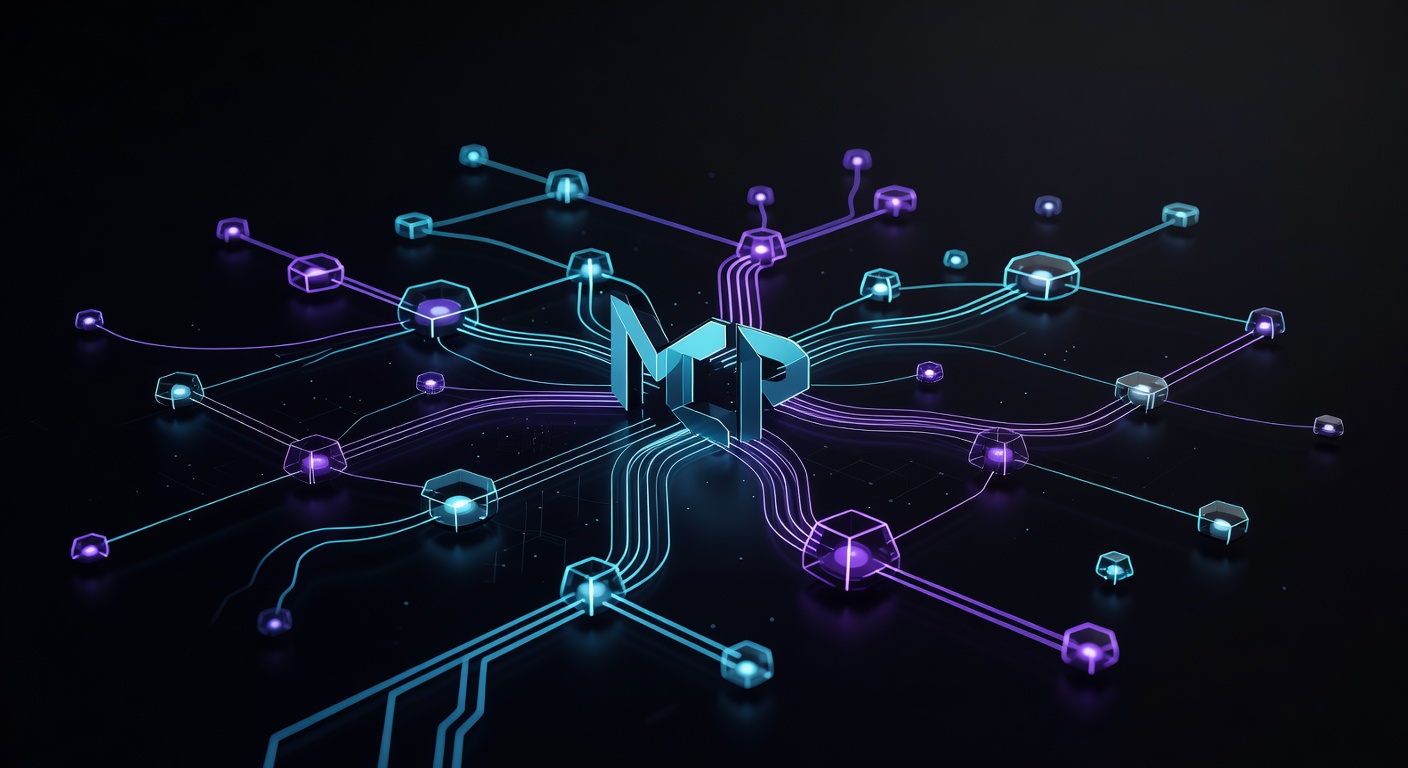
The genius of the design is that it separates the AI from the integration. An enterprise does not have to build one Claude integration and one ChatGPT integration and one Gemini integration. It builds one MCP server — for its Confluence, its Salesforce, its internal customer database — and every MCP-compatible agent inherits access. That is roughly the same architectural move that USB-C made for peripherals, and it is why the analogy has stuck.
Why MCP Won
Three things killed the alternatives.
It was open and specified. OpenAI’s function calling, by contrast, was a JSON schema embedded in a proprietary API. LangChain’s abstractions were code, not a protocol, which meant porting between providers was a rewrite, not a config change. MCP published a spec with a reference implementation and an SDK in both Python and TypeScript on day one, and Anthropic committed publicly not to charge for it.
It was agent-first, not chat-first. Function calling was designed to let a single LLM call a small number of functions in a single turn. MCP was designed from the start for multi-step agentic workflows where the agent might call a dozen tools from five different servers, pass context between them, and resume after human approval. That design premise maps onto what enterprises actually want to build — not chatbots, but automations.
Anthropic gave up control at the right moment. The December 2025 donation to the Linux Foundation was strategically smart. Enterprises and competitors will not standardize on a protocol controlled by a single AI vendor. By donating MCP to the Agentic AI Foundation before competitors could fork it, Anthropic traded private control for industry adoption — and the industry moved almost immediately.
The pattern is reminiscent of how small language models started winning the enterprise AI race and why buyers increasingly prioritize control and interoperability over raw model capability.
Where MCP Is Actually Deployed
By Q2 2026, four clusters of production deployment are visible.
Developer tooling. This was the first mover and remains the most mature. GitHub Copilot, Cursor, Zed, JetBrains, and VS Code all consume MCP servers for context — pulling in Jira tickets, internal docs, CI logs, and codebase search. The popular GitHub, Git, and Filesystem reference MCP servers are installed in hundreds of thousands of developer environments. The 97 million monthly SDK downloads number is inflated heavily by this category.
Customer support and CX. Enterprises are wrapping Zendesk, Salesforce Service Cloud, and their internal knowledge bases in MCP servers so that agent-assist tools and AI copilots can read ticket history and suggest resolutions. Intercom, Gorgias, and Front have native MCP connectors. The pattern here is typically read-only at first, with write actions (ticket updates, outbound messages) rolled out after governance matures.
Data and analytics. Snowflake, Databricks, BigQuery, Postgres, and ClickHouse all have MCP servers in active enterprise use. This is where the economic case is clearest: instead of building a custom text-to-SQL product for each vendor, you expose a schema-aware query tool via MCP and any agent can use it. Cloudflare published a reference architecture in April 2026 for deploying these servers with auth, rate limiting, and audit logging at the edge.
Agentic workflows. This is the most speculative and the fastest-growing category. Browser-using agents, back-office automation agents, security operations agents — all are consuming MCP tools to take real actions. It overlaps heavily with the trend we documented in the autonomous SOC, where AI now runs cybersecurity operations, and with the emergence of agentic browsers hitting enterprises with a new attack surface.
The Security Story Is the Story
MCP’s security profile is where most of the enterprise anxiety lives in 2026, and not without reason.
Prompt injection surface. Every MCP resource — every document, ticket, commit message, email — is content that will be read by an LLM. Attackers have demonstrated that malicious instructions embedded in a Jira ticket or a customer email can steer an agent into calling tools it should not. This is not hypothetical. Several major MCP server families have already shipped and then patched indirect prompt injection vulnerabilities, including ones that would let an attacker read private data by getting the agent to email it out.
Tool poisoning. Because MCP clients discover tools dynamically from servers they connect to, a compromised or malicious server can publish tools with innocuous names (“file-reader”) that actually exfiltrate data. This is the attack path highlighted in a widely-cited 2026 CoSAI white paper: a single compromised MCP server can be a gateway into an enterprise’s digital life if the client is trusting.
Credential blast radius. Each MCP server typically holds credentials or OAuth tokens for the service it wraps. Compromising the server is often equivalent to compromising every credential it holds. Enterprises are being forced to treat MCP servers as Tier 1 infrastructure — the same way they treat their identity providers — which is a maturity jump many are still making.
Write-action governance. The protocol itself has no opinion about when a tool call needs human approval. That is up to the client. In practice, this has meant enterprises gate all write tools through an approval workflow, at least initially, and expand auto-approval carefully as confidence builds. Anthropic’s Claude Desktop, Cursor, and Cloudflare’s AI Gateway all ship with approval modes; enterprises without those guardrails have seen real incidents.
The mitigation playbook that has emerged is roughly: pin MCP server versions, treat server code as supply chain (sign and scan), use a client that supports per-tool approval and audit, segregate read and write server endpoints, and run a gateway (Cloudflare, Kong, custom) between agents and MCP servers to enforce policy.
The Next Twelve Months
Three specific shifts are already underway.
Remote MCP becomes the default. The original MCP spec assumed local servers running on the user’s machine. The 2025 update added transport over HTTP with streamable responses, and the 2026 revision makes remote MCP a first-class deployment model. That matters because remote MCP is what makes multi-tenant, cloud-hosted MCP services economical. Expect AWS, Cloudflare, and Azure to launch managed MCP hosting products through 2026.
Authorization standardizes on OAuth. The protocol now formally supports OAuth 2.1 with dynamic client registration, which means an enterprise agent can authenticate to a remote MCP server using the same identity plumbing it uses for every other SaaS service. This is duller than it sounds and more important than almost any other change.
Marketplaces emerge. Anthropic, OpenAI, and Cloudflare have all announced MCP server registries or marketplaces. The question for 2026 is whether one registry becomes dominant (the way Docker Hub did for containers) or whether the space stays fragmented. Either way, discoverability and trust signals for MCP servers are about to become real product surface area.
Why This Matters Beyond AI
The bet MCP is making — and the bet the Linux Foundation is making by hosting it — is that agents will become a durable layer of enterprise software, not a temporary wrapper around chat. That implies the protocols that connect agents to data and tools will matter the way HTTP and SQL and OAuth have mattered — quiet infrastructure that shapes what is possible for decades.
There are counter-scenarios. Agents could remain narrow, model providers could re-assert proprietary integrations, or a next-generation approach could make MCP look like SOAP in a REST world. But the trajectory through April 2026 is hard to argue with. A protocol that went from zero to every major AI provider in 18 months, with 10,000 public servers and a Linux Foundation home, is a protocol that has won the cycle it was built for.
Bottom Line
MCP is not a feature. It is the connective tissue between AI agents and the enterprise. Builders choosing which tools to integrate, and buyers choosing which AI platform to standardize on, are increasingly making the MCP question their first question rather than their last. In 2026 the right answer is to adopt it — carefully, with governance, with security assumptions consistent with any Tier 1 infrastructure — because the competitive cost of not adopting it is getting more expensive by the quarter.
The quiet open-source protocol won. The interesting work now is building on top of it responsibly.
📚 You May Also Like
Gyucheol Choi
Senior Data Scientist · ImpriMed Korea
AI researcher specializing in precision medicine and drug sensitivity analysis. Covers AI tools, healthcare AI, and emerging tech with hands-on expertise.
Leave a Reply