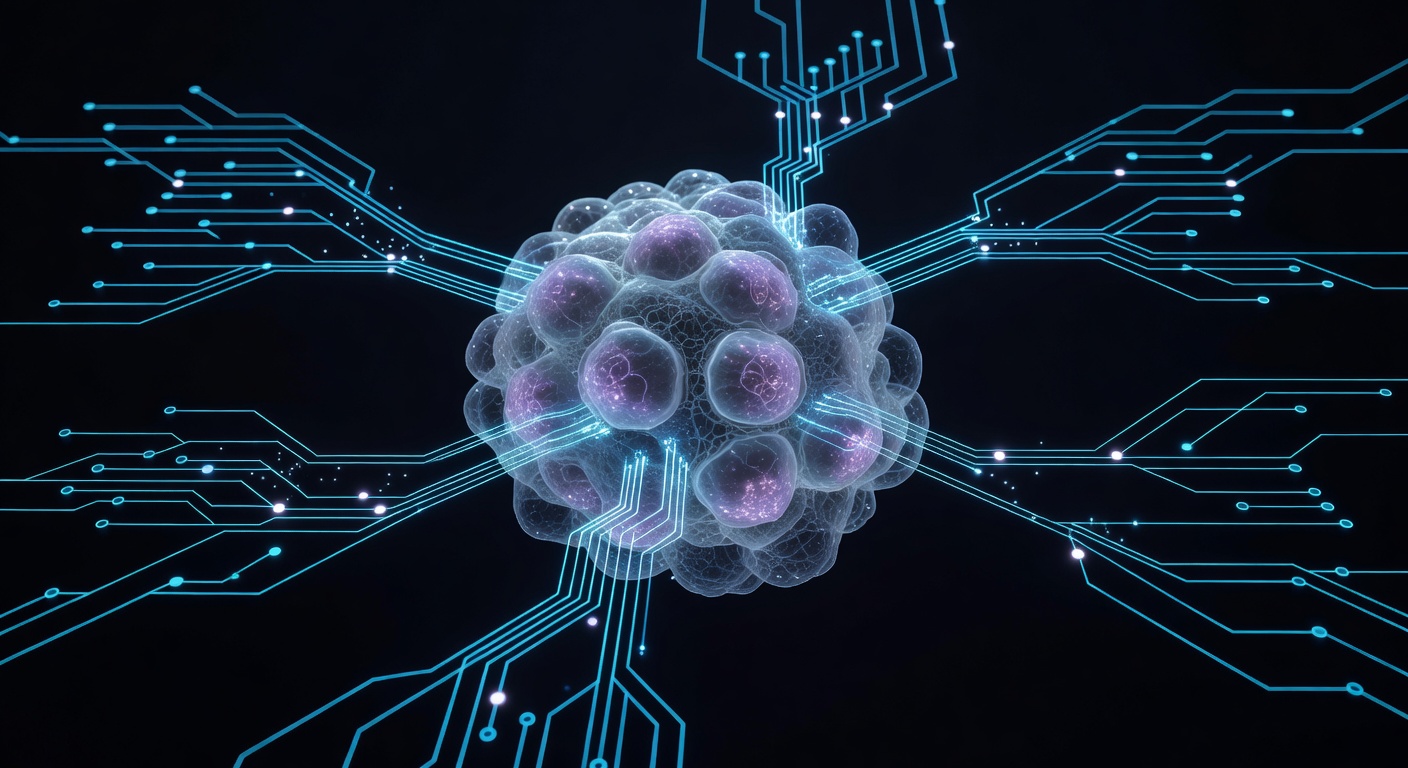
The shift from population averages to your tumor’s actual response
Standard chemotherapy regimens fail roughly half the time on first-line cancer treatment. The reason is brutal but simple: a drug approved for “colorectal cancer” was tested on a population, not on the specific genetic chaos inside your specific tumor. Oncologists have tried to fix this with genomic profiling — sequence the tumor, match mutations to targeted therapies. It works some of the time. The rest of the time, the targeted drug still fails because tumors are not just collections of mutations. They are living tissues with metabolic states, immune microenvironments, and resistance machinery that no DNA readout captures.
In 2026, a different approach has reached the clinic. Patient-derived organoids — three-dimensional mini-tumors grown from a biopsy in a dish — are now tested against dozens of cancer drugs in parallel, and AI reads the response to predict which therapy will work in the actual patient. The accuracy is no longer theoretical.
A consensus paper published across multiple oncology centers reports that organoid-based drug sensitivity testing achieves more than 90% sensitivity and specificity in predicting therapeutic response. That number is roughly double what standard genomic-only matching delivers in many tumor types. For an oncologist deciding between a first-line and second-line regimen, the difference is months of survival and tens of thousands of dollars in avoided ineffective treatment.
How a biopsy becomes a 50-drug screen in three weeks
The workflow has been compressed from a research curiosity into a clinical assay. A patient’s tumor biopsy or surgical specimen is digested into single cells, embedded in a basement membrane matrix, and grown into spheroidal mini-tumors that retain the original tumor’s architecture, mutations, and signaling pathways. Hundreds of these organoids per patient are then plated across 384-well or 1,536-well plates and exposed to a panel of approved oncology drugs at multiple concentrations.
What used to require thousands of organoids and weeks of manual handling has been miniaturized. A 2026 protocol described in npj Biomedical Innovations uses automated picking to seed as few as ten organoids per well, dropping turnaround from a research timeline to under three weeks — fast enough to fit between surgical resection and the start of adjuvant chemotherapy.
The bottleneck used to be readout. A 384-well plate generates millions of confocal images, terabytes of viability traces, and concentration-response curves that no pathology lab could interpret manually. That is where machine learning entered the loop and changed what these assays can return.
What the AI actually does
Three layers of AI now sit on top of an organoid drug screen.
First, computer vision models segment each organoid in each well across time. CNN-based pipelines distinguish viable, dying, and dead organoids, count them, and measure morphological changes that correlate with drug response far before a luminescence-based viability assay can detect cell death. This catches early apoptotic signals that traditional endpoint readouts miss.
Second, transformer architectures integrate the imaging data with the patient’s genomic, transcriptomic, and proteomic profile. A 2025 model called PharmaFormer, trained across more than 100 patient-derived organoid lines with linked multi-omics and pharmacology data, predicts clinical drug response with cross-tumor accuracy that matches in-house ex vivo readouts. The model uses transfer learning so a screen run on one patient’s organoid can inform predictions on related tumor types where less data exists — important for rare cancers that will never have their own training set.
Third — and this is the part the field has been waiting for — AI extracts biomarkers from the screens. When an organoid responds unexpectedly to an off-label compound, models cross-reference the response against multi-omics data to flag candidate predictive markers. That feeds back into companion diagnostics development. Several pharma companies are now running organoid panels alongside Phase 2 trials specifically to mine biomarkers that traditional pharmacogenomic approaches missed. Our earlier coverage of AI pharmacogenomics in real prescriptions shows the same pattern: AI is closing the loop between genotype, drug exposure, and clinical outcome.
The CLIA-certified assay that changed the conversation
The clearest signal that organoid-AI testing has crossed from research into care is the PARIS assay. Developed for biliary tract cancer, the CLIA-certified workflow profiles a patient’s organoid against more than 50 oncology drugs and uses AI-assisted pharmacotyping to generate a ranked sensitivity list. Real-time clinical decisions are now made using PARIS data in U.S. and European centers.
Biliary tract cancer was a deliberate first target. It is rare enough that there are no large genomic-match programs, aggressive enough that empirical second-line choices waste time the patient does not have, and biologically heterogeneous enough that population-level guidelines are weak. Organoid drug sensitivity testing solves all three problems at once, which is why the assay is now being extended to gastric, pancreatic, and head-and-neck cancers.
A 2025 paper in the Journal of Experimental and Clinical Cancer Research reported that osteosarcoma organoids correctly predicted neoadjuvant chemotherapy response in pediatric patients, with the organoid-based prediction correlating with histological response and long-term survival. That is the holy grail of preclinical testing: an ex vivo readout that survives the prediction-to-clinic gap.
Why the FDA pushed this forward
The regulatory environment changed in April 2025 when the FDA announced it would phase out mandatory animal testing for monoclonal antibodies and several other drug classes in favor of human-first preclinical models. That decision instantly pulled organoid platforms from “interesting alternative” to “preferred replacement.”
In October 2025, the FDA granted its first investigational new drug approval in oncology based exclusively on efficacy data from human vascularized organoids — the platform was developed by Qureator. The approval set a precedent: a drug entered first-in-human trials without ever being tested in a mouse. The vascularized aspect matters; second-generation organoid systems now incorporate endothelial networks, immune cells, and stromal components that recapitulate the actual tumor microenvironment. The drug response in those systems looks much closer to what happens in patients than what happens in monolayer cell lines.
This regulatory shift is what makes organoid drug sensitivity testing hard for payers to ignore. If the FDA accepts organoid efficacy data for IND filings, insurance companies have to take seriously the same data when used for treatment selection — particularly when 90%+ predictive accuracy translates directly into avoided cost of failed first-line therapy.
The blood cancer angle
Solid tumors got the first wave of organoid-AI work because they are physically easier to extract and culture as 3D structures. Blood cancers like leukemia and multiple myeloma require a different setup — typically suspension cultures or co-culture with bone marrow stromal cells — but the AI layer has translated cleanly. Ex vivo drug sensitivity profiling of primary leukemia cells, combined with machine learning models that integrate flow cytometry and single-cell RNA sequencing, has been used to guide relapsed AML treatment in academic medical centers since 2024.
For multiple myeloma, the picture is even more mature thanks to the parallel track on minimal residual disease monitoring. We covered the FDA’s adoption of MRD as a myeloma drug endpoint and the role of AI digital twins in myeloma treatment. Organoid-style ex vivo screens fit between those two: the patient’s cells get profiled against a drug panel before treatment, the AI predicts the regimen most likely to drive deep MRD-negative response, and the digital twin tracks the trajectory afterward.
The same logic is playing out in AI-driven cancer drug resistance prediction, where ex vivo profiling identifies the resistance pattern before the patient ever takes the drug.
What still has to happen for routine adoption
Three things are slowing universal rollout. First, success rates for organoid culture from a biopsy are not yet 100% — they range from 70% to 90% depending on tumor type, and a failed culture means the patient cannot use the assay. Second, the cost per screen is still in the low five figures, which is justifiable for high-stakes second-line decisions but not yet for every newly diagnosed patient. Third, payer reimbursement is uneven; some commercial insurers cover organoid drug sensitivity testing for specific indications, but Medicare coverage is still patchwork.
The cost curve is moving. Miniaturization is cutting reagent volumes by an order of magnitude, and the AI layer reduces the labor cost of analysis substantially. Several startups now offer subscription pricing for academic medical centers, with marginal cost per additional screen under $2,000. The same dynamic that pulled AI drug discovery costs from billions to millions is now playing out in clinical drug selection.
The deeper impact
The implication beyond oncology is harder to talk about because it changes how drugs are developed in the first place. If organoid-AI screens routinely identify which patients respond to which drug, biotech companies can run smaller, faster Phase 2 trials enriched for likely responders. Several 2026 trials are doing exactly that — preselecting patients based on organoid response and then testing the drug only in that population. Trial sizes drop, durations compress, and approval probabilities rise.
Critics raise reasonable concerns. Organoid models still miss components of the immune system unless explicitly co-cultured. The screen tests drug exposure, not immune-mediated efficacy, so checkpoint inhibitor predictions remain weaker. The biomarker discovery loop is also creating a flood of candidate predictive signatures that will need rigorous validation before they enter routine clinical use.
But the directional answer is clear. After two decades of “personalized medicine” mostly meaning “we sequenced your tumor and looked up the matching drug,” personalized treatment now means: we grew your tumor in a dish, screened it against the drugs we have, and let AI tell us which one to start with. The 90% accuracy is what makes that sentence different from a 2018 marketing slide.
The question for 2026 is no longer whether organoid drug sensitivity testing works. It is how fast every cancer center can stand up the lab capacity to run it for every patient who needs one — and whether the AI infrastructure to read the screens scales as fast as the wet lab does.
📚 You May Also Like
Gyucheol Choi
Senior Data Scientist · ImpriMed Korea
AI researcher specializing in precision medicine and drug sensitivity analysis. Covers AI tools, healthcare AI, and emerging tech with hands-on expertise.
Leave a Reply