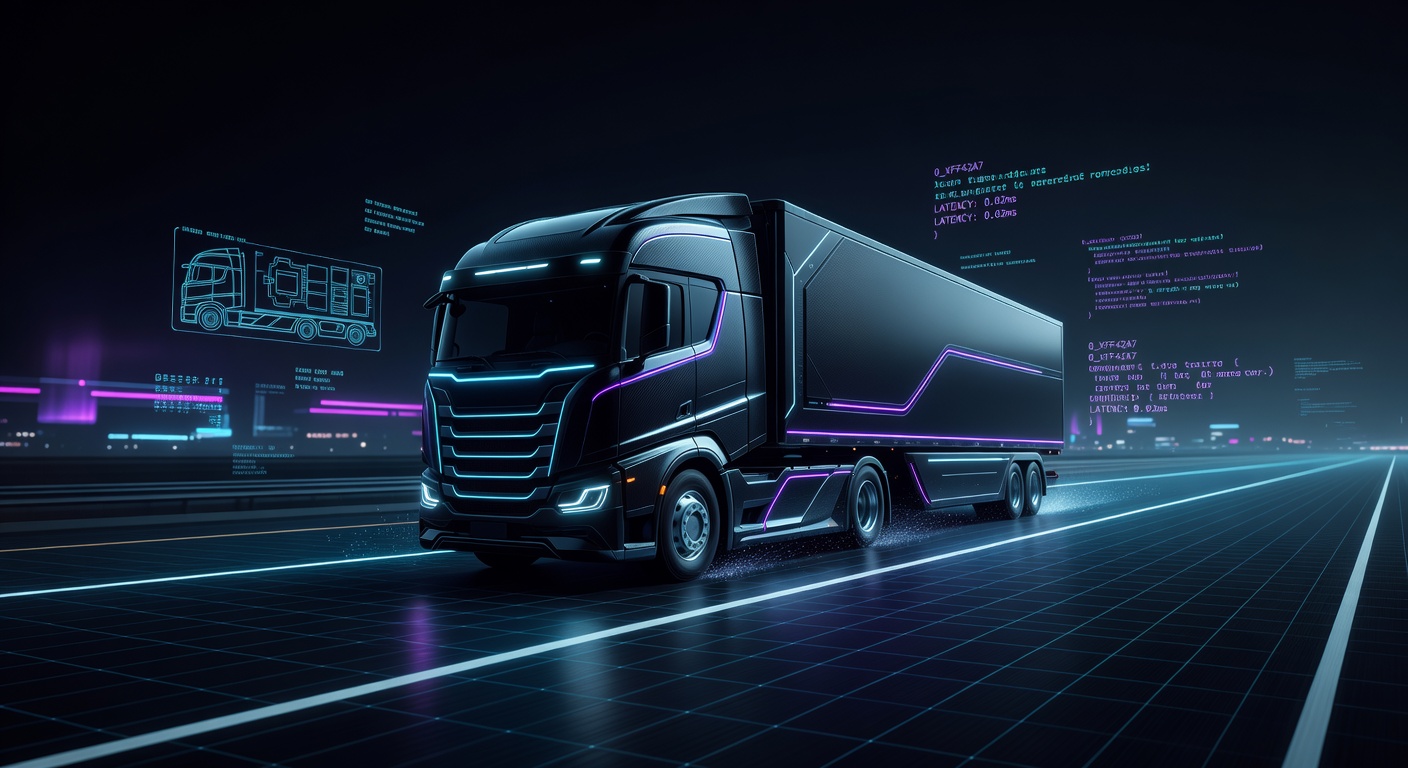
In February 2026, Aurora Innovation announced that its driverless trucks had carried 250,000 miles of revenue freight across the Sun Belt without a collision and could now run 1,000-mile lanes — Fort Worth to Phoenix — in 15 hours nonstop. A human driver legally cannot do that. Federal hours-of-service rules cap a single driver at 11 hours of driving in a 14-hour shift. Aurora’s trucks do not stop because they do not need to.
That sentence is the entire reason autonomous trucking has quietly leapfrogged passenger robotaxis as the most aggressive deployment of self-driving technology in the United States. The unit economics finally work, the regulatory environment is permissive, and the mission profile — repetitive interstate highway runs between fixed terminals — is the easiest possible problem in autonomy.
The freight industry knows this. Aurora’s network expanded to ten routes in the first quarter of 2026, with a target of more than 200 trucks by year-end. Kodiak AI is targeting fully driverless long-haul operation by the end of 2026 after running 20 driverless trucks for Atlas Energy Solutions in the Permian Basin oil patch. The trucking industry’s long-promised autonomous future has stopped being an indefinite target and started being a fleet plan.
Why Trucking Got There First
The case for driving without a driver in trucks is structurally cleaner than in passenger cars. Long-haul freight runs interstate-to-interstate on routes that look almost identical week to week. Highway driving has no pedestrians, no cyclists, no sudden lane changes from teenagers, no school buses. The operational design domain — the environment a self-driving system has to handle — is narrower by an order of magnitude.
Economics are also cleaner. A driverless truck that runs 22 hours a day instead of 11 is not a marginal upgrade. It doubles asset utilization without doubling capital cost. The U.S. trucking industry employs about 3.5 million drivers and is short roughly 60,000 of them at any given time, with annual driver turnover at large carriers running above 90 percent. Replacing or augmenting that labor pool is worth tens of billions of dollars per year if the math holds.
The mission is also more forgiving. Tesla’s robotaxi service in Austin has to handle drop-offs on residential streets with humans and dogs in the path. Tesla’s reality is one robotaxi per city right now precisely because that environment is hard. Aurora’s trucks pick up sealed trailers at a freight terminal, take a fixed highway route, and drop the trailer at another freight terminal. No customer interaction. No surprise stops. Just miles.
The Stack That Got Aurora There
Aurora’s vehicle is built on a Peterbilt 579 or Volvo VNL platform with a sensor stack including FMCW lidar, long-range radar, and high-resolution cameras. The lidar is the differentiator. Frequency-modulated continuous-wave lidar can measure both the position and the velocity of distant objects directly, giving the perception system about 400 meters of useful range — enough to react to a stalled vehicle on the highway shoulder before a human even sees it.
The second layer is the safety case. Aurora maintains what it calls the “Aurora Driver Safety Case Framework,” a several-thousand-page document covering every claim about the system’s capabilities and the evidence behind each claim. Truck operations had to satisfy that framework before the safety driver came out. After Aurora pulled the safety driver in mid-2024, the company has logged a quarter million revenue miles without a collision. That number is small by passenger autonomous standards — Waymo’s autonomous fleet has now passed tens of millions of cumulative miles — but it represents a different kind of mile. Each Aurora trip is roughly 800 to 1,000 miles, all interstate, with continuous freight loads. The miles-per-intervention metric for highway driving is now favorable enough that fleets are actively bidding for capacity.
Kodiak’s Different Path
Kodiak AI did not start on highways. The company spent the back half of 2024 and most of 2025 driving 20 trucks for Atlas Energy Solutions in the Permian oil basin, hauling sand to fracking sites on private dirt roads in the harshest environment a truck can encounter. Dust, heat, no GPS coverage, unstructured terrain. The argument was that a system that works in the Permian works on Interstate 10.
That bet appears to be paying off. Kodiak announced its highway driverless launch is targeted for the second half of 2026 with an Autonomous Readiness Metric of 78 percent as of late 2025. The company has signed scale-up partnerships with Bosch for hardware and with several large carriers for capacity commitments. Kodiak’s pitch is that its perception system, hardened in industrial conditions, will handle long-tail edge cases — flooded roads, debris, lane closures — better than a system trained primarily on clean highway data.
The DOT and the Federal Patchwork
Federal Motor Carrier Safety Administration rules currently allow autonomous commercial motor vehicles to operate without a driver in the cab as long as state law permits. Texas, Arizona, New Mexico, Oklahoma, Florida, and several other Sun Belt states have permissive frameworks. California does not yet allow heavy-truck autonomy, which is why the early commercial deployments are clustered in the southern tier of the country.
The federal rulemaking is still incomplete. NHTSA published a long-awaited proposal in late 2025 covering automated driving system inspection, certification, and oversight, with public comment closing in 2026. Until that rule is final, autonomous trucking is governed by a patchwork of state law and FMCSA waivers. The companies are deploying anyway, on the bet that early operational data will shape the final rule.
There is also the question of what happens when something goes wrong on a road shared with hundreds of other freight carriers. The first fatal accident involving a fully driverless commercial truck in the United States has not happened. When it does — and engineers in the industry are direct that the question is when, not if — the regulatory response will define the next phase. Aurora and Kodiak have both invested heavily in scenario-based safety arguments precisely because they expect the public conversation to demand them.
Hub-and-Spoke Replaces Door-to-Door
The deeper change is in network design. Long-haul autonomous trucks are not a one-for-one replacement for human drivers. They are a different freight architecture. Trucks run sealed, terminal-to-terminal, on a fixed inter-city network. Human drivers handle the first and last twenty miles — the “drayage” leg — between terminal and customer dock. The economics favor concentrating freight at automated hubs near interstate exits and using human drivers only for short, urban runs.
That looks similar to how passenger air travel works. Aircraft do not fly to your driveway. They fly hub to hub, and other modes handle the last leg. Trucking is restructuring along the same lines. Several of the biggest U.S. carriers — Werner, Schneider, Knight-Swift, Hub Group — are already building autonomous-compatible terminals in Dallas, Phoenix, El Paso, and Atlanta. The network is forming faster than the public realizes.
What Is Still Hard
The remaining problems are real. Severe weather is one. Heavy rain degrades lidar performance, and current systems pull off the road during storms in ways that complicate scheduled freight delivery. Construction zones with hand-directed traffic are another. So is anything urban. Aurora and Kodiak both explicitly avoid city driving in their commercial product.
Cybersecurity is the third. A driverless truck is a 40-ton networked vehicle. Compromising one is closer to compromising a server farm than a passenger car. The industry is starting to take this seriously, with autonomous-vehicle threat models echoing the broader agentic-AI security questions emerging across enterprise computing.
The fourth is the human factor: dispatch, terminals, customer relations, brokerage. As Kodiak’s CEO has said, the self-driving technology is only half the battle. The rest is operating a freight company at scale — back-office systems, fuel cards, weigh stations, DOT inspections, accident response. Aurora and Kodiak are now building those operating muscles, not just the autonomy stack.
Where This Lands
The 2026 trajectory looks like a few hundred driverless trucks on Sun Belt routes by year-end, scaling toward several thousand by 2028 as Aurora’s pilot platform and Kodiak’s Atlas-validated platform both go to series production. The freight network will reorganize around autonomous-compatible corridors. Some human drivers will move to higher-paying short-haul drayage work. Others will leave the profession.
The broader implication is that long-haul trucking is the first major sector where self-driving has commercial pricing power. Aurora is selling miles, not vehicles, and the pricing per loaded mile is now competitive with traditional carriers. Once a service is cheaper, faster, and reliably available, customers move. The economic case for autonomous trucking has been argued for a decade. In 2026, the argument is over. The trucks are running.
📚 You May Also Like
Gyucheol Choi
Senior Data Scientist · ImpriMed Korea
AI researcher specializing in precision medicine and drug sensitivity analysis. Covers AI tools, healthcare AI, and emerging tech with hands-on expertise.
Leave a Reply