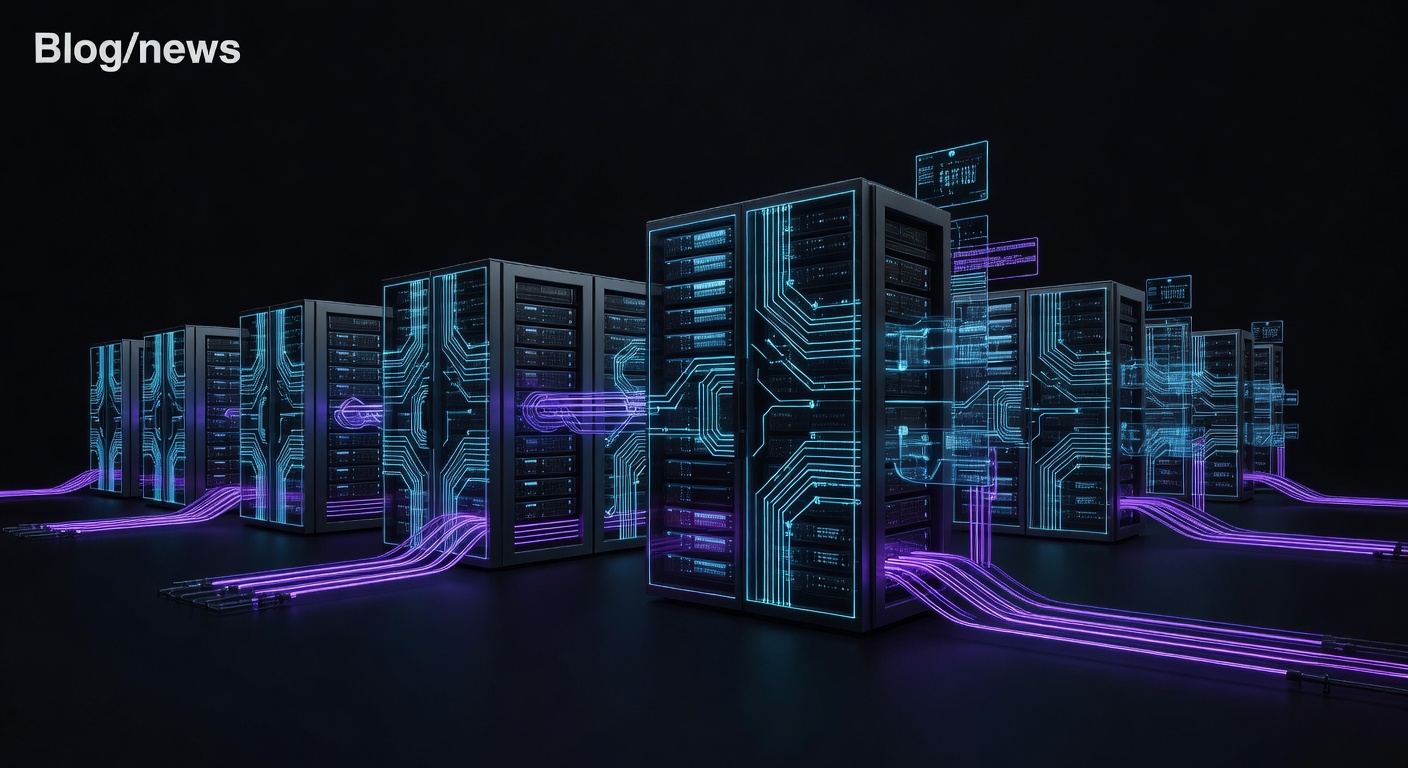
AI is now half of America’s new electricity demand
US data centers consumed 183 terawatt-hours in 2024, equal to roughly 4 percent of the country’s total electricity use, or about what Pakistan consumes in a year. By the close of 2026, the International Energy Agency projects global data center electricity to cross 1,000 TWh — roughly Japan’s annual output. The US share of that growth is the part that has the grid operators worried. Data centers now account for about half of all new electricity demand in the United States, and the growth curve is steepening, not flattening.
The driver is AI training and inference, not general cloud workload. A standard hyperscale rack used to draw 10 to 14 kilowatts. An AI training rack with the latest Nvidia GPUs draws 40 to 70 kilowatts, with next-generation configurations pushing past 100 kW. That tenfold jump in power density per rack is the engineering reality behind every projection in this article. The grid was not built for it.
PJM, the warning shot
PJM Interconnection runs the grid for 13 states from New Jersey through Virginia and serves the largest concentration of data centers in the country, including the Northern Virginia cluster that handles a meaningful share of global internet traffic. PJM’s own forecast projects a 6 gigawatt capacity shortfall by 2027 — roughly the output of six full-scale nuclear reactors — because data center load growth is outrunning new generation interconnection.
The market price signals have already moved. PJM’s 2025-2026 capacity auction cleared at nearly ten times the prior year’s price. Retail electricity rates across the PJM footprint have climbed more than 15 percent in some service territories, and Goldman Sachs estimates that data center power consumption alone will add 0.1 percent to core inflation in both 2026 and 2027. That is small in macroeconomic terms but visible on a household electric bill, and it is the basis for the political backlash now forming around data center construction.
US retail electricity prices are up 42 percent since 2019. Not all of that is data centers — fuel costs, transmission upgrades, and weather-driven demand all contribute — but the data center share is the line item growing the fastest. In Virginia and Ohio, where utilities have publicly broken out the data center cost allocation, the share is enough that consumer advocacy groups have filed formal complaints arguing residential ratepayers are subsidizing hyperscaler infrastructure.
The $1.4 trillion utility build-out
America’s investor-owned utilities have collectively published a $1.4 trillion capital spending plan through 2030, a 27 percent jump over last year’s projection. The line items are dominated by transmission, generation, and substation upgrades sized for AI data center load. Dominion Energy, Duke Energy, Southern Company, AEP, and Exelon have all filed multi-year integrated resource plans that explicitly model AI growth as the single largest assumption.
The challenge is that capital is the easy part. New transmission lines take 7 to 10 years from siting to commissioning, and the AI capacity demand is showing up on a 2 to 3 year horizon. The math does not close. That gap is what is driving every other story in this space — the nuclear restarts, the gas peaker plant orders, the corporate power purchase agreements, and the small modular reactor procurement deals all flow from the same underlying problem.
Local opposition is also slowing things down. At least 16 data center projects worth a combined $64 billion were blocked or delayed in 2024 by zoning fights, water-use objections, or grid interconnection disputes. Northern Virginia’s Loudoun County, the densest data center cluster on Earth, has imposed effective moratoriums on new construction in several districts. Phoenix, Atlanta, Columbus, and Dallas are seeing similar pushback.
The nuclear restart wave is real
Big tech has signed contracts for more than 10 gigawatts of potential new nuclear capacity in the US over the past 18 months. The most-watched deal is Microsoft’s agreement with Constellation Energy to restart the 835-megawatt Crane Clean Energy Center, formerly Three Mile Island Unit 1. The plant is targeted for 2027 operation, a year ahead of original estimates, with output dedicated to powering Microsoft’s AI clusters on the PJM grid.
That deal hit a real obstacle in early 2026 when PJM’s market monitor objected to the proposed waivers and determined that transmission upgrades for the restart would not finish until December 2030. Constellation’s $1.6 billion plan is still going forward, but the regulatory and grid-integration side is harder than the press releases suggested. The lesson is that turning nuclear plants back on is genuinely possible, but the surrounding grid infrastructure is the bottleneck that nobody priced in.
Meta has signed agreements totaling more than 6 gigawatts of nuclear capacity, including purchase agreements with Vistra Corp. for output from existing plants and partnerships with Oklo and TerraPower for small modular reactors slated for the early 2030s. Google has signed with Kairos Power for SMR capacity. Amazon acquired Talen Energy’s Cumulus Data Assets campus, which sits next to the Susquehanna nuclear plant and gives AWS direct co-location with 960 megawatts of behind-the-meter nuclear power.
The reason every hyperscaler is doing the same deal at the same time is that nuclear is the only firm, low-carbon, gigawatt-scale power source with a credible build path. Renewables plus storage cannot meet the load profile of AI training, which runs at high duty cycle 24/7 and is sensitive to interruption. Gas peakers can fill the gap but conflict with corporate net-zero commitments. Nuclear matches the load shape and the carbon math, which is why the industry is suddenly relevant again after twenty years of stagnation.
SMRs are not coming fast enough
Small modular reactors are the technology the industry is betting on for the second half of the decade. SMRs in the 50 to 300 MW range can be factory-built, sited closer to data centers, and deployed in a few years rather than the 10-plus that conventional nuclear takes. NuScale, Oklo, X-energy, TerraPower, Holtec, and a handful of others are racing for first commercial deployment.
The honest assessment is that none of those reactors will be producing power before 2030, and most realistic schedules slip to 2031 or 2032. That timeline is well past the AI demand surge, which means SMRs solve the second-half-of-the-decade problem but not the immediate one. The first-half solution is whatever combination of restarted nuclear, new gas, transmission upgrades, and demand-response can be assembled in three years or less.
That is why some data center operators are turning to behind-the-meter gas generation as a stopgap. Building gigawatt-scale gas plants on-site to power AI clusters bypasses the grid interconnection queue entirely. It also obliterates the operator’s emissions accounting, which is the trade-off that the industry is now openly making.
What it means for the AI buildout
The power constraint is starting to shape model architecture decisions. We covered some of this in our piece on neuromorphic chips coming for GPU AI inference, where the case for non-GPU inference architectures is largely about energy per token, not raw throughput. The same logic is driving the enterprise shift toward smaller models for production workloads — a 7B parameter model running on the right silicon can serve real traffic at a fraction of the GPU and power footprint of a 400B frontier model.
On-device inference is getting a similar push. Smartphones running LLMs without the cloud is partly a privacy story, but the energy economics are also part of it. Inference that runs on a phone’s NPU at sub-watt power does not show up in a data center’s electricity bill at all, and that matters now in a way it did not in 2023.
The companies running frontier model training do not have those exits. Training runs the size of GPT-class and Claude-class models require gigawatt-hour energy budgets that can only be met by the kinds of infrastructure deals described above. The AI lab capex story and the utility capex story are now the same story.
The political backlash is starting
Public sentiment has shifted faster than anyone expected. Pew polling from late 2025 shows a majority of Americans concerned about data center growth in their region, and the share saying they would oppose a new data center near them has climbed in every quarterly survey since early 2024. The objections are concrete: higher electricity bills, water usage in dry regions, noise from cooling systems, and the sense that the local community is bearing the cost of infrastructure that primarily benefits hyperscaler shareholders.
Several states have begun moving on it. Virginia is debating legislation that would let utilities allocate data center grid costs directly to data center customers rather than spreading them across all ratepayers. Ohio passed similar legislation in early 2026. Texas, which has so far been the most accommodating state for AI infrastructure, is starting to see grid stress that may force a similar conversation by the end of the year.
The Federal Energy Regulatory Commission is also paying closer attention. FERC has signaled it will review the structure of behind-the-meter generation arrangements like the Talen-Amazon deal, where data centers consume power from co-located generation without paying transmission charges. If FERC tightens that interpretation, the economics of the next wave of co-location deals get worse, and the whole industry’s planning assumptions shift.
What changes through 2026
Three things to watch. First, the next round of AI lab funding rounds will be evaluated partly on contracted power supply, not just compute access. Investors are starting to ask which gigawatts a frontier lab has nailed down through 2028, because the answer is now a real differentiator. Second, expect at least one major utility to announce a multi-gigawatt nuclear restart or new build directly tied to a single AI customer, similar to the Microsoft-Constellation deal but on a larger scale. Third, watch for the first state to pass a data center moratorium that actually sticks. The political incentive structure is moving that way faster than the industry has acknowledged.
The constraint that limits AI for the rest of this decade is not chips, not data, and not algorithms. It is electrons. The companies and regulators that figure out how to get them where they need to go on time will be the ones that get to ship the next generation of models.
📚 You May Also Like
Gyucheol Choi
Senior Data Scientist · ImpriMed Korea
AI researcher specializing in precision medicine and drug sensitivity analysis. Covers AI tools, healthcare AI, and emerging tech with hands-on expertise.
Leave a Reply