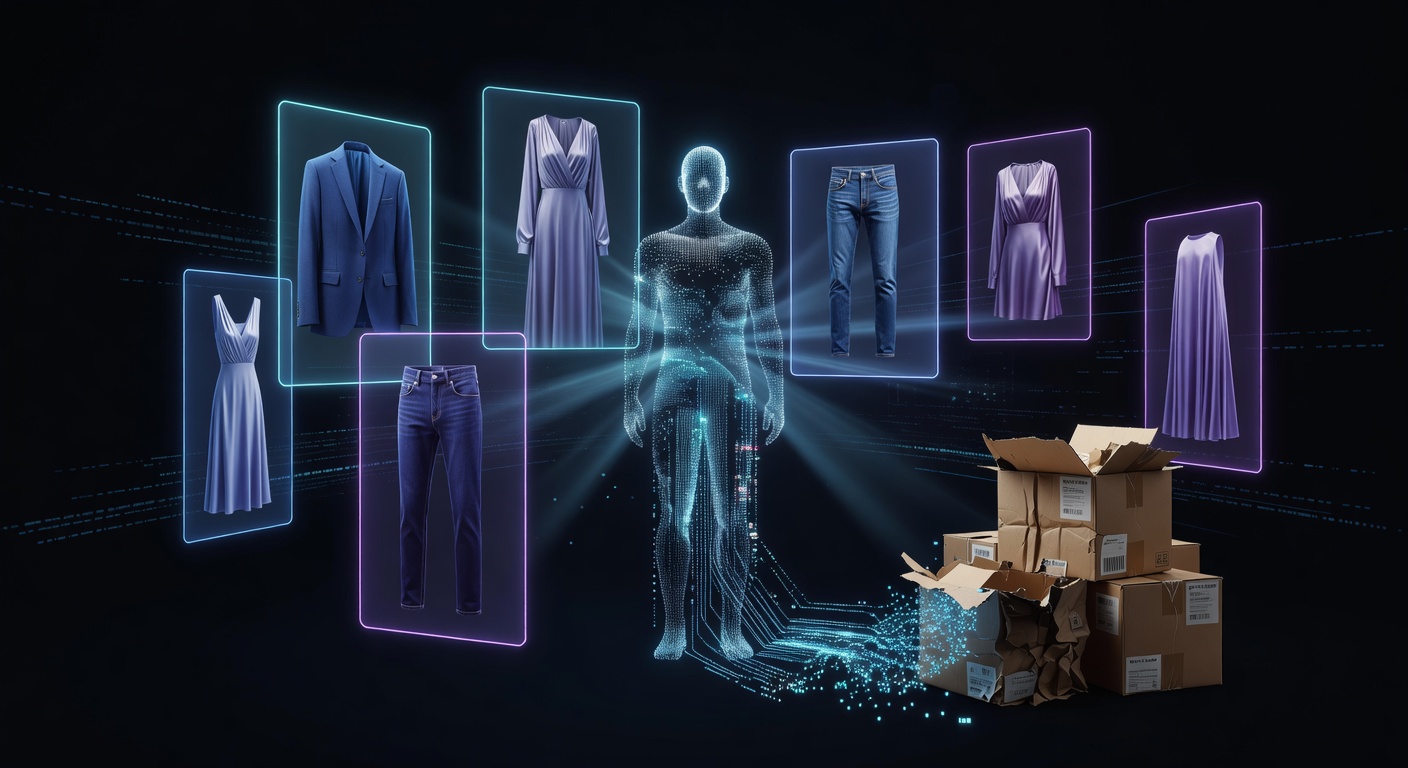
Every year, American retailers lose staggering amounts of money to product returns. The U.S. National Retail Federation estimated that 15.8% of annual retail sales were returned in 2025, totaling $849.9 billion. For online purchases specifically, the return rate climbed to 19.3%. The primary reason shoppers send items back is simple: they were not sure the product would fit or look right when they ordered it.
For decades, this uncertainty has been baked into the economics of e-commerce. Retailers priced in returns as a cost of doing business. Shoppers ordered multiple sizes and sent back what did not work. The environmental waste, shipping costs, and processing overhead accumulated into what industry insiders call the “silent killer” of retail margins.
Now, generative AI is changing the equation. Virtual try-on technology — powered by sophisticated image generation models — lets shoppers see exactly how clothing, accessories, and cosmetics will look on their specific body before they click “buy.” And the early results suggest this is not just a gimmick. It is a margin-saving tool that is starting to reshape how people shop online.
How the Technology Actually Works
Modern AI virtual try-on systems go far beyond the crude overlay tools of five years ago. Google’s Virtual Try-On feature, which expanded across its shopping platform in early 2026, uses a custom image generation model trained to understand how different materials interact with the human body.
The system accounts for fabric physics — how cotton drapes differently from silk, how denim folds at joints, how a loose fit looks versus a tailored cut. Users upload a photo of themselves, and the AI generates a realistic composite image showing the garment on their body, matched to their proportions, skin tone, and pose.
Behind the scenes, these models are trained on massive datasets of clothing images paired with body measurements and fabric metadata. The AI learns not just what a shirt looks like flat on a hanger, but how it behaves when worn by someone who is 5’4″ versus 6’1″, size 6 versus size 14.
Several companies are competing hard in this space:
- Google integrated virtual try-on directly into product search results, making it accessible without visiting individual retailer sites. Starting April 30, 2026, this feature works across all Google shopping surfaces.
- AIUTA partnered with ASOS to bring deep-tech virtual fitting to millions of fashion shoppers, using proprietary body modeling and garment simulation.
- Vue.ai offers retailers an end-to-end platform that combines virtual try-on with AI-driven styling recommendations.
- Zeekit (acquired by Walmart) has been integrated into Walmart’s online fashion offerings, enabling try-on across thousands of SKUs.
The Numbers That Are Getting Retailers’ Attention
The business case for virtual try-on technology is becoming difficult to ignore. ASOS, the UK-based online fashion retailer, reported a 160 basis point reduction in its returns rate after implementing AIUTA’s virtual try-on system. For a company processing billions in annual revenue, that reduction translates directly into millions saved on reverse logistics, restocking, and damaged inventory.
But reduced returns are only part of the story. Retailers using virtual try-on are also seeing:
- Higher conversion rates. When shoppers can see how an item looks on them, they are more confident in their purchase decision. Several retailers report double-digit percentage increases in add-to-cart rates for products with try-on enabled.
- Larger basket sizes. Shoppers who use virtual try-on tend to browse more items and buy more per session, because the friction of uncertainty is removed.
- Lower customer acquisition costs. The interactive, personalized experience drives organic sharing on social media, as users post their virtual try-on images and tag the brands.
A 2026 Snowflake analysis of retail AI adoption found that 87% of retailers say AI tools have had a positive impact on revenue, while 94% reported reduced operating costs. Virtual try-on is one of the most visible and consumer-facing applications driving these numbers.
Beyond Clothing: Where Virtual Try-On Is Heading
While apparel has been the primary use case, virtual try-on technology is expanding rapidly into adjacent categories.
Eyewear. Companies like Warby Parker and EssilorLuxottica have implemented AI-powered virtual frame try-on that maps facial geometry in real time. Unlike earlier AR-based tools that simply overlaid a flat image, newer systems adjust for face shape, ear position, and nose bridge width to show how glasses will actually sit.
Cosmetics. L’Oreal’s ModiFace and Perfect Corp’s YouCam have been leaders in virtual makeup try-on for years. In 2026, these tools have advanced to the point where they can simulate product textures — the sheen of a lip gloss, the matte finish of a foundation, the shimmer of an eyeshadow — with near-photographic accuracy.
Furniture and home decor. IKEA’s AI-powered room planner and similar tools from Wayfair let shoppers place virtual furniture in photos of their actual living spaces. The technology accounts for lighting conditions, wall colors, and existing furniture to produce realistic previews.
Sneakers and footwear. Nike and Adidas have both invested in foot-scanning and virtual try-on technology that goes beyond appearance to predict comfort and fit based on 3D foot models.
The Technical Challenges That Remain
Despite real progress, virtual try-on technology still faces significant hurdles.
Body diversity. Training data has historically skewed toward certain body types, leading to less accurate results for shoppers outside those ranges. Companies are actively working to expand their training datasets, but closing this gap requires deliberate effort and diverse data collection.
Fabric accuracy at scale. While the technology works impressively for common fabrics, unusual materials — heavily beaded garments, sheer fabrics, complex patterns — can still produce artifacts or unrealistic renders. Each new fabric type effectively requires additional training data.
Real-time performance. Generating a high-quality virtual try-on image takes computational power. On mobile devices with limited processing capacity, there is often a tradeoff between image quality and response time. Edge computing and model optimization are helping, but the experience is not yet instant everywhere.
Privacy concerns. Virtual try-on requires users to share photos of themselves, often in form-fitting clothing. How retailers store, process, and protect these images is a growing concern. Some companies process images entirely on-device to avoid sending body photos to remote servers, while others rely on cloud processing with strict deletion policies.
What This Means for Physical Retail
Interestingly, virtual try-on is not just an online tool. Physical retailers are experimenting with in-store smart mirrors and kiosks that use the same AI technology. These installations let shoppers see how items look without the hassle of carrying armfuls of clothing into a fitting room.
Nordstrom has tested smart mirror concepts in select locations. H&M has piloted in-store body scanning for personalized size recommendations. The goal is not to replace physical fitting rooms entirely, but to reduce the friction that causes shoppers to abandon items rather than try them on.
For brick-and-mortar stores competing with the convenience of online shopping, these tools offer something that pure e-commerce cannot: an immediate, tactile experience enhanced by AI precision.
The Environmental Angle
The sustainability implications of reduced returns are substantial. Each returned item generates carbon emissions from shipping, often in both directions. Many returned garments — particularly in fast fashion — end up in landfills rather than being resold, because the cost of inspection, repackaging, and restocking exceeds the item’s value.
Optoro, a returns management company, estimated that returned merchandise generates 24 million metric tons of CO2 emissions annually in the United States alone. If virtual try-on technology can reduce return rates by even a few percentage points across the industry, the environmental benefit compounds quickly.
Several brands are now marketing their virtual try-on features explicitly as sustainability tools, appealing to environmentally conscious consumers who want to minimize waste.
The Road Ahead
By 2030, analysts project the AI-powered retail market could represent a $3 to $5 trillion global opportunity. Virtual try-on is positioned as one of the most consumer-visible applications of retail AI, alongside personalized recommendations and automated customer service.
The technology is advancing on multiple fronts simultaneously. Better generative models will produce more realistic images. Wider adoption of 3D body scanning — through smartphone LiDAR sensors and dedicated hardware — will give the AI more accurate input data. And as more retailers share anonymized fit data, the models will improve at predicting not just how clothing looks, but how it actually fits and feels.
For shoppers, the promise is straightforward: buy with confidence, return less, and discover styles you might never have tried in a physical store. For retailers, the math is equally clear: fewer returns, higher margins, and happier customers.
The $850 billion return problem will not disappear overnight. But for the first time, the tools to meaningfully shrink it are available — and they are getting better fast.
Related: I Tested 7 AI Password Managers | Related: AI-Powered Health Apps That Work in 2026
📚 You May Also Like
Gyucheol Choi
Senior Data Scientist · ImpriMed Korea
AI researcher specializing in precision medicine and drug sensitivity analysis. Covers AI tools, healthcare AI, and emerging tech with hands-on expertise.
Leave a Reply