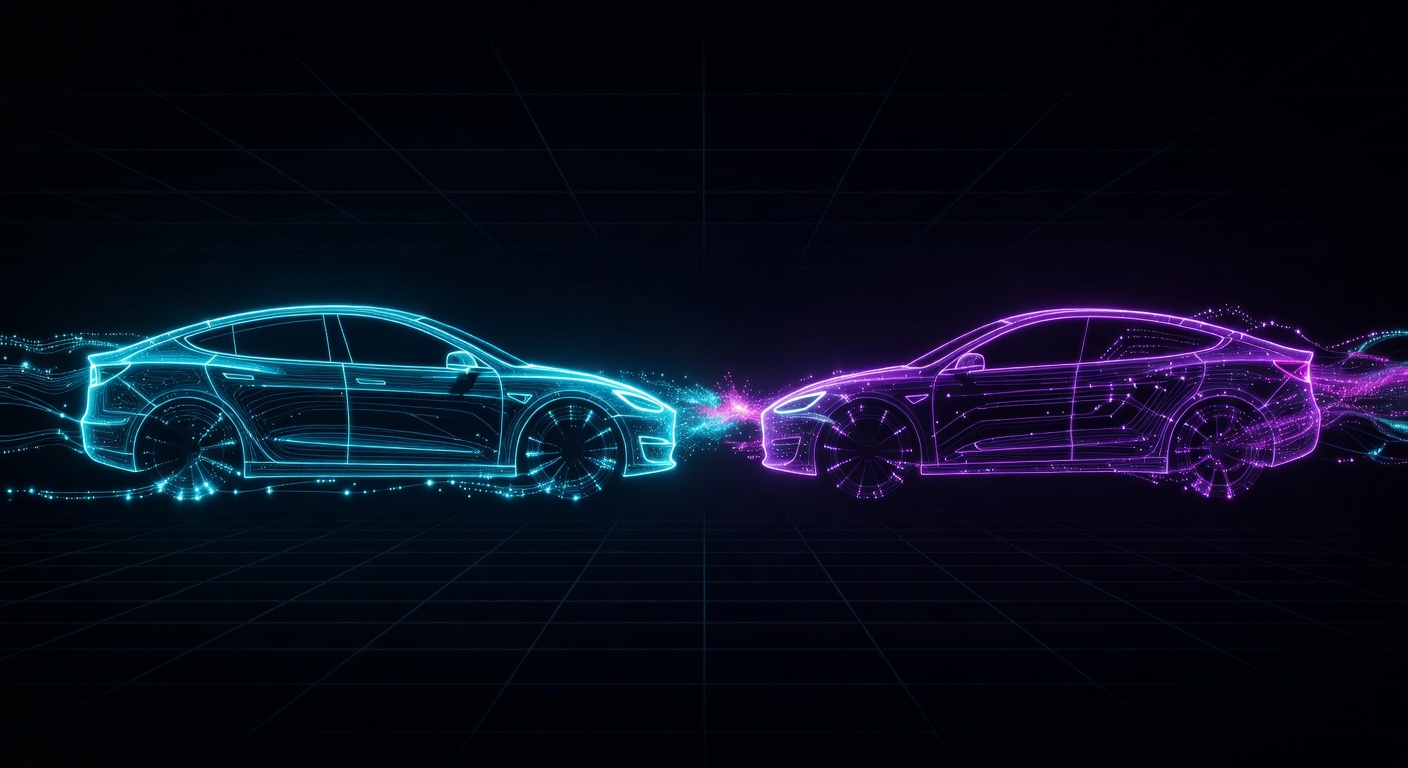
The Ultimate Autonomous Driving Showdown
Three weeks ago, I embarked on the ultimate self-driving car experiment. Armed with access to both Tesla’s Full Self-Driving (FSD) Beta and Waymo’s robotaxi service in San Francisco, I put both systems through identical real-world scenarios to answer the question everyone’s asking: which autonomous driving technology actually works better?
After 150+ miles of testing, dozens of complex traffic situations, and more than a few white-knuckle moments, the results surprised me. Here’s my detailed comparison of these two radically different approaches to solving autonomous driving.
The Tale of Two Technologies
Tesla and Waymo represent completely opposite philosophies in autonomous driving. Tesla relies on cameras and neural networks, betting that vision-based AI can solve driving like humans do. Waymo uses a combination of LiDAR, cameras, and radar with detailed 3D maps, creating a highly controlled but geographically limited system.
“After three weeks of testing, I realized we’re not just comparing two cars—we’re comparing two fundamentally different visions of how autonomous vehicles should work.”
My testing covered urban streets, highway driving, parking scenarios, and challenging weather conditions across San Francisco and the broader Bay Area.
Tesla FSD: The Bold Generalist
Tesla’s FSD impressed me with its ambitious scope. Unlike Waymo’s geofenced service area, Tesla attempts to drive anywhere, anytime. During my testing, the system handled construction zones, unexpected detours, and rural roads that weren’t in any mapping database.
The neural network approach showed remarkable adaptability. When faced with a broken traffic light, FSD treated it as a four-way stop—exactly what a human driver should do. It handled double-parked cars, cyclists weaving through traffic, and even a loose dog running across the street with appropriate caution.
However, the system’s confidence sometimes exceeded its capabilities. On steep San Francisco hills, FSD occasionally hesitated at stop signs longer than necessary. During heavy rain, it became noticeably more conservative, sometimes to the point of frustrating other drivers.
Waymo: The Cautious Perfectionist
Waymo’s robotaxi experience felt like riding with the world’s most cautious driving instructor. The vehicles never exceeded speed limits, always signaled well in advance, and maintained generous following distances. In its operational domain, Waymo rarely made mistakes.
The LiDAR-based system excelled in complex scenarios. At a busy intersection with multiple pedestrians and cyclists, Waymo tracked each moving object with precision, predicting their paths and adjusting accordingly. The vehicle’s ability to “see” in 360 degrees was particularly impressive during lane changes on busy highways.
But Waymo’s limitations became apparent at the borders of its service area. The system simply wouldn’t operate outside specific neighborhoods, making it useful only for local trips within San Francisco’s urban core.
| Aspect | Tesla FSD | Waymo | Winner |
|---|---|---|---|
| Geographic Coverage | Nationwide | Limited cities | Tesla |
| Safety Record | Good with supervision | Excellent | Waymo |
| Complex Scenarios | Adaptable but inconsistent | Reliable within limits | Waymo |
| Cost to Consumer | 2,000 one-time | 5-40 per ride | Tesla |
| Weather Performance | Struggles in heavy rain | Consistent performance | Waymo |
| Human Intervention | Required supervision | Fully autonomous | Waymo |
The Real-World Test Scenarios
I designed specific tests to challenge both systems:
Construction Zone Navigation: Tesla FSD adapted to lane closures and flag persons dynamically. Waymo handled pre-mapped construction zones flawlessly but struggled when encountering unexpected work sites.
Pedestrian Interactions: Both systems were appropriately cautious, but Waymo’s 360-degree sensing gave it an edge in crowded areas like Fisherman’s Wharf.
Parking Challenges: Tesla’s parking assist worked in any location, including tight parallel spaces. Waymo avoided complex parking situations entirely, dropping passengers at designated zones.
The Intervention Factor
Over three weeks, I had to intervene in Tesla FSD situations 23 times. Most were precautionary—times when the system would have probably handled the situation fine, but I wasn’t comfortable letting it proceed. Waymo required zero interventions but also operated in a more controlled environment.
“The fundamental question isn’t which system is better today, but which approach will scale to solve autonomous driving everywhere, for everyone.”
Tesla’s approach feels more ambitious but riskier. Waymo’s method is safer but potentially less scalable to global deployment.
Cost and Accessibility Analysis
From a consumer perspective, the economics are vastly different. Tesla’s 2,000 FSD package (or 99/month subscription) provides unlimited use across your entire ownership experience. Waymo charges per ride, typically 5-40 depending on distance and time.
For daily commuters, Tesla becomes cost-effective quickly. For occasional users, Waymo’s on-demand model makes more financial sense. But Waymo’s limited geographic availability restricts its practical utility for most consumers.
The Technology Behind the Curtain
Tesla’s camera-only approach processes visual information similarly to human drivers, making it theoretically more adaptable to new scenarios. The system continuously learns from the fleet’s collective driving data, improving through over-the-air updates.
Waymo’s sensor-heavy approach provides more reliable environmental understanding but requires extensive mapping and testing for each new area. The trade-off is between scalability and reliability.
What Surprised Me Most
The biggest surprise wasn’t technical—it was psychological. Riding in Waymo felt like being driven by a professional chauffeur. Using Tesla FSD felt like teaching a teenager to drive—sometimes impressive, sometimes nerve-wracking, but always improving.
Tesla’s system showed more “personality” in its driving decisions. It would accelerate confidently through yellow lights, take slightly wider turns for passenger comfort, and even adjust its driving style based on traffic flow. Waymo drove like a computer—perfectly but predictably.
The Verdict: It Depends
After three intensive weeks, I can’t declare an absolute winner because these systems serve different needs:
Choose Waymo if you need maximum safety and reliability for local urban trips. The technology is more mature and requires no human oversight.
Choose Tesla FSD if you want widespread geographic coverage and don’t mind supervising the system. It’s better for road trips, suburban driving, and areas where Waymo doesn’t operate.
Both represent incredible engineering achievements, but they’re solving different versions of the autonomous driving problem. Waymo optimizes for safety in controlled environments. Tesla optimizes for adaptability in the real world.
Looking Ahead
The future likely belongs to whoever can combine Waymo’s reliability with Tesla’s scalability. Tesla is gradually improving safety through data and iterations. Waymo is slowly expanding geographic coverage.
For now, I’m keeping both options available. Tesla FSD for my daily driving needs, Waymo for specific trips in San Francisco where I want to relax completely.
The autonomous driving revolution isn’t a single breakthrough—it’s two different paths converging toward the same destination. We’re privileged to witness this technological evolution firsthand.
Tesla FSD Information | Waymo Official Site | NHTSA Autonomous Vehicle Guidelines
📚 You May Also Like
Gyucheol Choi
Senior Data Scientist · ImpriMed Korea
AI researcher specializing in precision medicine and drug sensitivity analysis. Covers AI tools, healthcare AI, and emerging tech with hands-on expertise.
Leave a Reply