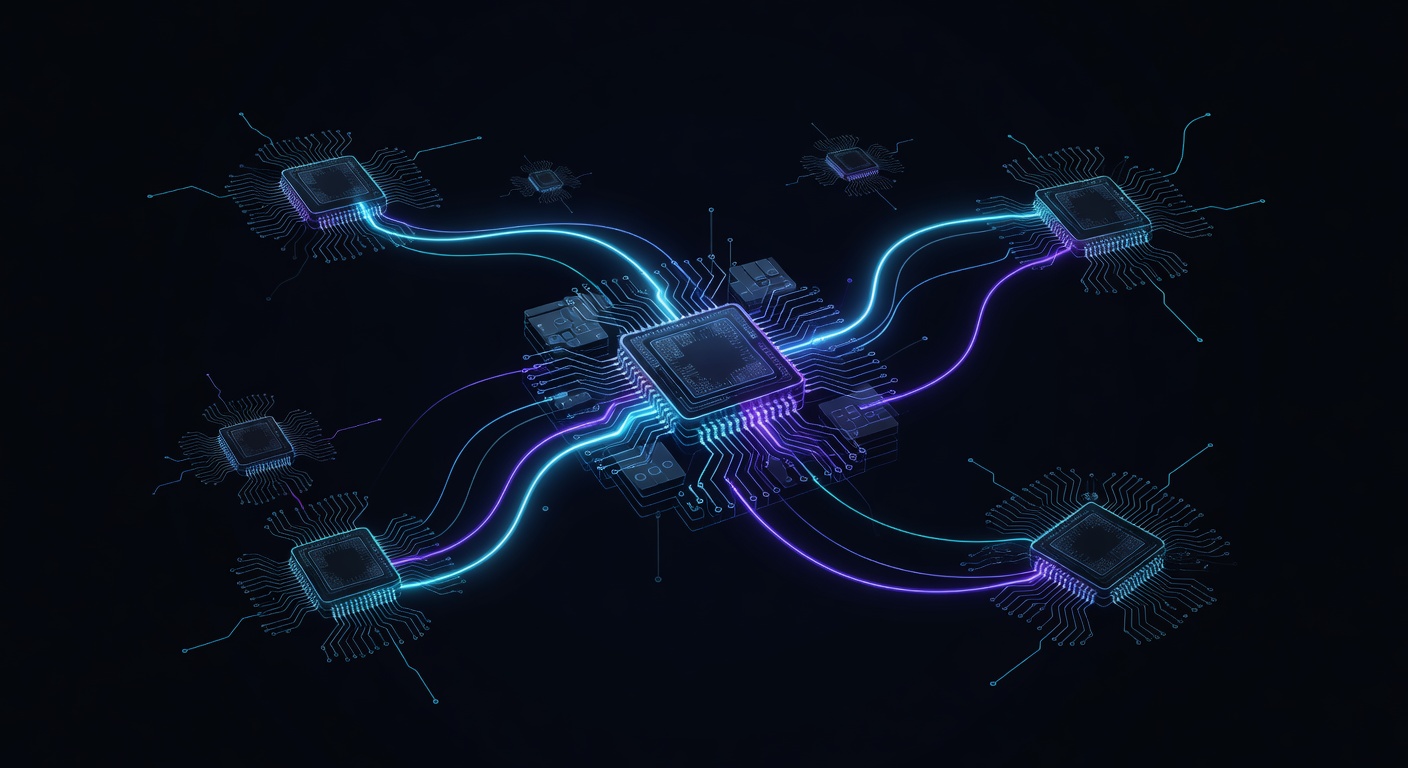
The recursion finally closed in 2026. The chips that train and serve large language models are now being designed, optimized, and verified by AI tools running on the previous generation of those same chips. What looked like a clever marketing line two years ago became this year’s industrial reality, with measurable effects on chip design timelines, cost structures, and the competitive positioning of every fabless company that ships silicon.
Three datapoints from the first quarter make the shift hard to ignore. Nvidia took a roughly $2 billion stake in Synopsys to deepen integration between CUDA-accelerated EDA and Synopsys.ai workflows. Cadence raised its 2026 outlook on the back of accelerating AI-driven design adoption and announced a deeper partnership with Nvidia spanning EDA and robotics. And Synopsys folded Ansys multiphysics engines into its design platform under the new Multiphysics Fusion banner, collapsing what used to be three separate tool stacks into one AI-orchestrated flow. The pattern is clear: the EDA industry, after a decade of incremental ML features, has restructured around AI as the primary interface to chip design.
What Used to Take Months Now Takes Weeks
The headline number from the Synopsys side is the cleanest expression of what changed. Synopsys.ai has compressed full chip design cycles by as much as twelve months in real customer deployments and reduced design cost by up to sixty percent. That is not a vendor-best-case benchmark on a toy design. Those are reported customer outcomes on production silicon at advanced nodes, where every week of schedule slip costs millions in opportunity and competitive position.
The mechanism is straightforward once you stop thinking of AI as an autocomplete and start thinking of it as a search optimizer. Modern chip design is a multi-objective problem with billions of degrees of freedom: gate-level placement, routing, power-grid balancing, clock-tree synthesis, signal-integrity tuning, and signoff verification across multiple operating corners. Human designers handle this by partitioning the problem and iterating, often in tight serial loops where one team’s output is the next team’s input.
AI changes the unit of iteration. Reinforcement learning agents like Cadence Cerebrus and Synopsys.ai DSO.ai explore the design space autonomously, testing hundreds of placement and routing strategies in parallel and learning which patterns deliver better Power, Performance, and Area on a given process node. What used to be five or six manual iterations becomes thousands of automated iterations, and the best of those iterations is often objectively better than what an experienced engineer would have produced.
The Multiphysics Holy Grail Just Got Solved
The harder problem is what engineers call multiphysics signoff. A modern 3-nm chip is not just a logic problem. It generates heat, flexes under thermal stress, leaks current at extreme densities, and radiates electromagnetic interference that couples back into its own analog blocks. For years, electrical, thermal, mechanical, and EM analysis lived in separate tools with separate file formats, and integrating them was a manual nightmare that often shipped late in the design cycle when fixes were expensive.
Synopsys’s Multiphysics Fusion stack, built on the Ansys engines acquired in the 2025 transaction, finally puts all of those analyses inside the same AI-optimized loop. Multiphysics Fusion ships first for timing signoff, multi-die design, design closure, and analog/mixed-signal applications, which are exactly the four areas where late-stage surprises kill schedules. When a placement decision affects timing, thermal profile, and signal integrity at the same time, the AI optimizer can now see all three consequences at once rather than discovering them in three separate tools weeks later.
Cadence’s framing of the same idea is “Physical AI,” in which chiplet-based designs get validated inside a virtual environment that mirrors the real performance characteristics of the target hardware before any silicon is taped out. The bet is that as designs move from monolithic dies to chiplet assemblies, the inter-chiplet interactions are what will eat schedules in 2026 and 2027, and only AI-driven cross-domain optimization will keep up.
Nvidia Is Now Both Customer and Partner
The Nvidia-Synopsys structural deal is the most important industry signal. Nvidia is the largest chip designer in the world by market cap, ships some of the most complex SoCs ever fabricated, and is now an equity-aligned partner in the EDA platform it uses to design those SoCs. The CUDA acceleration layer underneath Synopsys tools turns into a flywheel: Nvidia ships better GPUs, Synopsys runs faster on those GPUs, design cycles for the next Nvidia GPU shrink, and the cycle compounds.
The performance numbers are real. Synopsys benchmarks show 12x, 15x, and 20x scale-up on the Nvidia B200 platform, with PrimeSim projected to run 30x faster and Proteus 20x faster on Blackwell. Those speedups are not theoretical; they are the difference between running a full signoff regression overnight versus running it during a coffee break. The next-generation Nvidia Rubin platform is reportedly being designed using exactly this stack, which means the Rubin tape-out timeline is structurally faster than its predecessors regardless of what else changes.
The Cadence partnership covers similar ground from a different direction, with deeper integration between Cadence’s design and verification tools and Nvidia’s robotics and AI agent platforms. Cadence’s framing extends EDA from chip design into full system design, which matters for autonomous vehicles, humanoid robots, and any product where silicon, sensors, and software need to be co-designed.
Where the AI Actually Shows Up in the Flow
For engineering teams, the AI is most visible in three places.
Floorplanning and placement. RL agents now generate floorplans that beat experienced designers on PPA in many cases, especially on novel architectures where there is no prior layout to copy. The agent does not get tired, does not have a favorite block placement, and does not stop iterating at lunch.
Verification regression. Modern verification suites generate millions of test vectors. AI tools cluster failures by root cause, prioritize the test cases most likely to expose new bugs, and triage waveform dumps faster than any human team. Verification is still the long pole in most projects, but the pole is shorter than it was two years ago.
Analog and mixed-signal sizing. Analog design was the last refuge of pure human craft in chip design. AI-driven sizing flows now match expert analog designers on simple blocks and outperform them on complex blocks where the design space is too large to explore by hand. The shortage of senior analog designers, which has been a chronic industry problem, is finally meeting a real productivity tool.
The Same Patterns Are Hitting Every Layer of Computing
The chip-design recursion is one part of a broader pattern in 2026 where AI tools are restructuring the engineering disciplines that build computing infrastructure. AI coding agents are doing junior-engineer work in software. Neuromorphic chips are reshaping inference economics. AI data centers now drive half of new US power demand, and the chip designs they require are themselves being designed by AI. Small language models are winning enterprise deployment partly because they fit on chips designed by AI to run them efficiently.
What is unusual about the EDA shift is the speed. Software engineering has been absorbing AI for three years and the productivity gains are still hotly debated. Chip design absorbed AI inside eighteen months and the productivity gains are showing up directly in vendor revenue, customer schedules, and tape-out cadence. The reason is structural: chip design is a tightly closed-loop optimization problem with clear objective functions, plenty of training data from prior tape-outs, and customers willing to pay seven figures per seat for tools that demonstrably move PPA numbers.
What This Means for the Rest of the Industry
For fabless companies, the calculus is changing. Smaller teams can now ship competitive designs at advanced nodes because AI handles the routine parts of physical design that used to require dozens of headcount. That narrows one of the moats that incumbents like Apple, Qualcomm, and Nvidia have relied on for years.
For TSMC and the foundries, the AI flow is becoming the de facto path to advanced nodes. Process design kits, technology files, and signoff rules are now co-developed with the EDA vendors and tuned for AI-driven flows from the beginning, which means the foundry-EDA interface is tightening rather than commoditizing.
For Synopsys and Cadence, the strategic position has rarely been better. Both companies sit at a chokepoint where every silicon design has to pass through their tools, both have aligned with Nvidia at the deepest technical level, and both are turning AI from a feature into a platform. Cadence raised its 2026 outlook on this trend, and the activist investor pressure on the EDA sector has been about accelerating the AI roadmap rather than slowing it.
For Nvidia, the deal locks in tooling alignment for the next two GPU generations and positions the company to capture the full stack of compute infrastructure design, not just the chips themselves.
The Bottom Line
Chip design used to be a craft that took thousands of engineers thirty months to deliver a leading-edge SoC. In 2026, that timeline is collapsing toward eighteen months, the headcount is going down, and the chips coming out the other end are denser, more efficient, and more thermally well-behaved than they would have been under the old flow. The AI inside the EDA tools is being trained on the data generated by the chips it designs, which run the AI inside the EDA tools.
The recursion has closed, and from now on every leap in AI capability will feed back into the silicon that runs it. That is the real story of the 2026 EDA transformation, and it is the reason the next five years of compute progress will look different from the last five.
📚 You May Also Like
Related Articles
- AI Is Now Designing the Chips That Power AI
- AI Is Engineering ADCs That Cancer Can’t Outsmart
- Pathology AI Is Catching Cancers That Humans Miss
Gyucheol Choi
Senior Data Scientist · ImpriMed Korea
AI researcher specializing in precision medicine and drug sensitivity analysis. Covers AI tools, healthcare AI, and emerging tech with hands-on expertise.
Leave a Reply