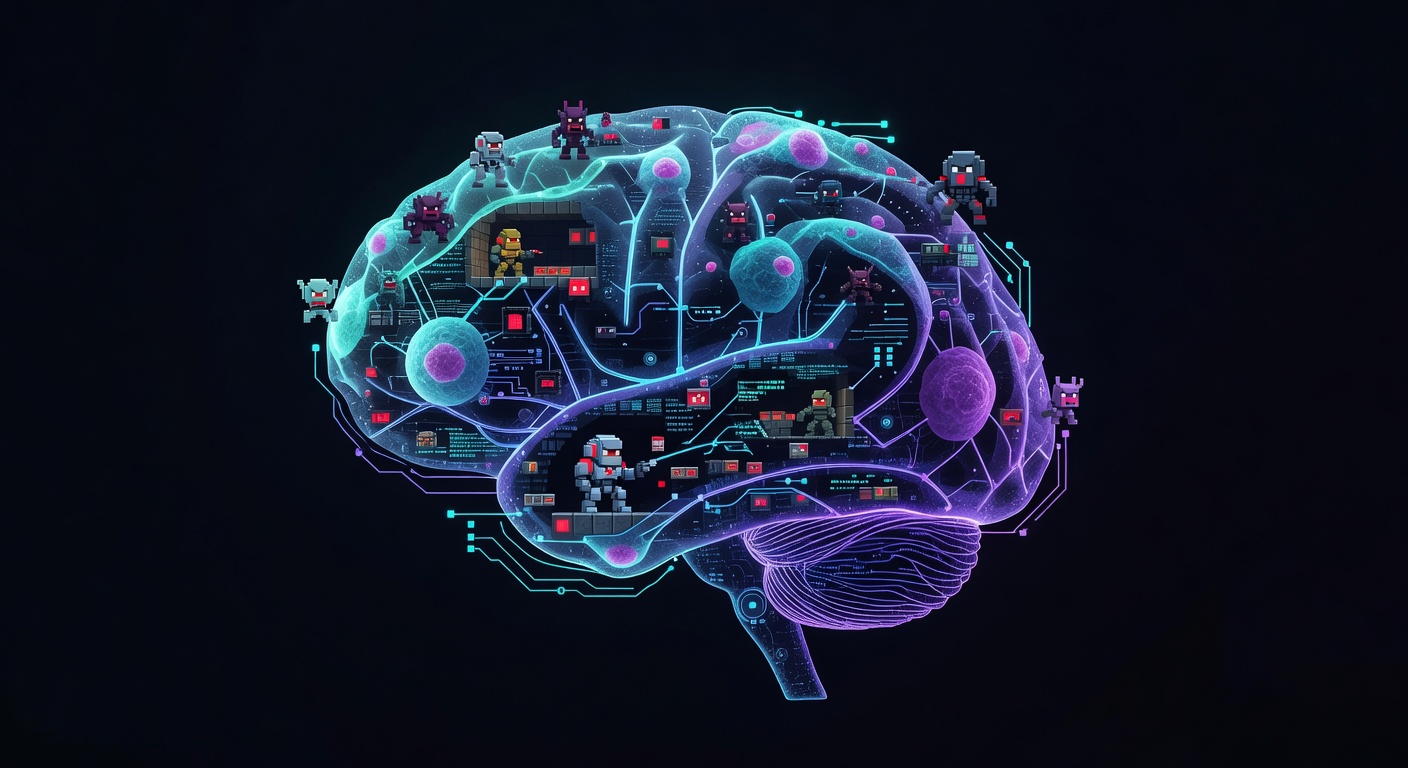
Scientists just achieved something that sounds like science fiction: human brain cells in a petri dish learned to play the classic video game DOOM. This breakthrough isn’t just a cool party trick – it’s potentially the foundation for a completely new type of computing that could change AI, medical treatments, and our understanding of consciousness itself.
What Actually Happened in This Experiment?
Researchers at Cortical Labs grew human brain cells in a laboratory dish and connected them to a computer system that could translate DOOM’s visual information into electrical signals the cells could understand. Within days, these biological neurons learned to control the game’s paddle and respond to the game environment.
The Technical Breakdown:
- 800,000 human brain cells grown on a chip
- Electrical stimulation patterns representing game states
- Real-time feedback between cells and game environment
- Learning demonstrated within 5 minutes of gameplay
Why DOOM? The Perfect Test Case
DOOM isn’t just a nostalgic choice – it’s actually ideal for testing biological intelligence:
- Simple inputs:Basic movement and shooting commands
- Clear feedback:Immediate consequences for actions
- Measurable performance:Easy to track improvement
- Well-documented:Decades of AI research using the same game
The Science Behind Biological Computing
How Brain Cells Learn Without a Brain
Here’s the fascinating part: these isolated brain cells demonstrate learning behavior through a process called synaptic plasticity. When neurons fire together repeatedly, their connections strengthen, creating memory patterns and learned responses.
Key Mechanisms:
- Synaptic strengthening through repeated activation
- Network formation between connected neurons
- Pattern recognition through electrical signal processing
- Adaptive behavior based on feedback loops
The DishBrain Paper: What the Research Actually Shows
The foundational study behind this work was published in the journal Neuron in October 2022 by Brett Kagan and colleagues at Cortical Labs, titled “In vitro neurons learn and exhibit sentience when embodied in a simulated game-world” (Kagan et al., Neuron, Vol. 110, Issue 23, pp. 3952-3969). The system they built, called DishBrain, interfaced living neurons with silicon hardware using high-density multielectrode arrays capable of both recording from and stimulating individual neurons across 26,400 electrodes simultaneously.
The performance metrics were striking. DishBrain neurons showed statistically significant improvement in gameplay rally length within five minutes of real-time feedback, outperforming control conditions where stimulation was randomized. The biological neural networks achieved a mean rally length roughly 35% longer than baseline after just 20 minutes of training. For comparison, a standard reinforcement learning algorithm like DQN typically requires thousands of episodes of training data to reach equivalent performance on simplified game tasks. The biological system got there with orders of magnitude less data, demonstrating a sample efficiency that silicon-based deep learning still struggles to match.
What made the learning possible was a feedback mechanism rooted in the Free Energy Principle, a theoretical framework developed by neuroscientist Karl Friston at University College London. Predictable electrical stimulation signaled successful actions such as hitting the ball, while unpredictable, noisy stimulation indicated failure. The neurons self-organized to minimize unpredictable input, effectively learning to play the game in order to reduce their own sensory surprise. This represents a fundamentally different learning approach from backpropagation-driven gradient descent, the workhorse of modern deep learning, and it worked with no labeled training data whatsoever.
Worth noting: a follow-up study published in 2023 by the same group demonstrated that adding common pharmaceutical compounds to the DishBrain system measurably altered gameplay performance, confirming the platform’s viability as a drug screening tool. Ethanol, for instance, degraded rally performance in a dose-dependent manner that closely mirrored known effects on human cognition. That result alone opens a significant pathway toward replacing animal models in early-stage pharmaceutical testing.
Comparing Biological vs Silicon Computing
| Aspect | Human Brain Cells | Traditional AI |
|---|---|---|
| Learning Speed | 5 minutes | Hours to days |
| Energy Usage | Extremely low | High (GPUs required) |
| Adaptability | Continuous | Requires retraining |
| Pattern Recognition | Intuitive | Statistical |
| Hardware Requirements | Biological support | Silicon chips |
Practical Applications: What This Means for 2026 and Beyond
Medical Breakthroughs on the Horizon
Drug Testing Revolution:
- Test neurological drugs on actual human brain tissue
- Predict medication effects before human trials
- Personalized medicine using patient-specific cells
- Faster development of treatments for Alzheimer’s and Parkinson’s
Prosthetics and Brain Interfaces:
- More intuitive brain-computer interfaces
- Prosthetics that learn user preferences
- Direct neural control of external devices
- Restoration of motor function after spinal injuries
Computing and AI Applications
Honestly, this could completely change how we think about artificial intelligence:
Hybrid Biological-Digital Systems:
- AI that adapts and learns like human brains
- Ultra-low power consumption for mobile devices
- Pattern recognition that rivals human intuition
- Self-repairing and self-organizing computer systems
The Ethical Questions We Need to Address Now
Consciousness and Sentience Concerns
Real talk: if brain cells can learn and adapt, what does that mean for consciousness? This research raises uncomfortable questions:
- Do isolated brain cells experience anything resembling consciousness?
- What are our ethical obligations to biological computing systems?
- How do we ensure consent when using human-derived cells?
- Should there be limits on how complex these systems can become?
Regulation and Oversight Challenges
Current regulations weren’t designed for biological computing. We need new frameworks for:
- Safety standardsfor biological computer systems
- Ethical guidelinesfor human cell-based research
- Privacy protectionsfor biological data
- International cooperationon biological computing governance
Investment and Business Opportunities
Companies to Watch in 2026
This technology is attracting serious investor attention:
- Cortical Labs:Pioneering biological computing research
- Neuralink:Brain-computer interface development
- Kernel:Neural interface technology
- BrainGate:Medical device applications
- Synchron:Minimally invasive neural interfaces
Market Projections and Potential
Industry analysts predict explosive growth:
| Market Sector | 2026 Value | 2030 Projection | Growth Rate |
|---|---|---|---|
| Brain-Computer Interfaces | .4 billion | .8 billion | 34% CAGR |
| Biological Computing | 50 million | .2 billion | 49% CAGR |
| Neural Prosthetics | .8 billion | .1 billion | 29% CAGR |
What This Means for Everyday Technology
Near-Term Applications (2026-2028)
Smartphones and Personal Devices:
- Ultra-efficient AI assistants that learn your preferences
- Cameras that intuitively understand what you want to photograph
- Battery life measured in weeks, not days
- Personalized health monitoring using biological sensors
Gaming and Entertainment:
- Games that adapt to your skill level in real-time
- NPCs with genuinely unpredictable behavior
- Immersive experiences that respond to your emotional state
- Virtual reality that feels truly responsive
Long-Term Possibilities (2030+)
Thing is, we’re probably only seeing the tip of the iceberg:
- Biological computersintegrated into everyday objects
- Self-healing technologythat repairs itself
- Truly intelligent homesthat anticipate needs
- Medical devicesthat grow and adapt with patients
Challenges and Limitations
Technical Hurdles
Scaling Issues:
- Maintaining cell cultures for extended periods
- Scaling from thousands to millions of neurons
- Ensuring consistent performance across different cell batches
- Integration with existing digital infrastructure
Reliability Concerns:
- Biological systems can be unpredictable
- Temperature and environmental sensitivity
- Potential for cellular degradation over time
- Difficulty in debugging biological processes
Practical Implementation Barriers
Look, there are real challenges to bringing this technology mainstream:
- Cost:Currently extremely expensive to maintain cell cultures
- Expertise:Requires specialized knowledge in both biology and computing
- Infrastructure:Needs sterile, controlled environments
- Regulation:Unclear approval processes for biological computing devices
How to Stay Updated and Get Involved
Following the Research
Key Journals and Publications:
- Nature Neuroscience
- Science Advances
- IEEE Transactions on Biomedical Engineering
- Frontiers in Neuroengineering
Educational Opportunities
If this field interests you, here are ways to get involved:
- University programsin bioengineering and computational neuroscience
- Online coursesin neural networks and biological systems
- Industry conferenceson brain-computer interfaces
- Research internshipsat neurotechnology companies
The Bottom Line: A New Era of Computing
The fact that human brain cells can learn to play DOOM represents more than just a scientific curiosity – it’s a glimpse into a future where the boundaries between biological and artificial intelligence blur completely.
We’re potentially looking at computing systems that:
- Learn and adapt continuously
- Use a fraction of current energy requirements
- Solve problems in ways traditional AI cannot
- Bridge the gap between human intuition and machine processing
Honestly, this technology could be as transformative as the development of the microprocessor or the internet. The next decade will likely determine whether biological computing becomes a niche research area or the foundation for an entirely new technological revolution.
For now, we’re watching history unfold in petri dishes and laboratory experiments. But soon, these biological computers might be everywhere – in our phones, our cars, our homes, and maybe even integrated with our own biological systems.
The age of biological computing has officially begun, and it’s going to be fascinating to see where it takes us.
📚 You May Also Like
- → Best AI Trading Platforms 2026: Complete Comparison of Automated Trading Software
- → Apple Vision Pro 2 Release Date 2026: Price Predictions and Pre-Order Guide
- → Best VPN Services 2026: ExpressVPN vs NordVPN vs Surfshark Comparison
Related Articles
- Driverless Trucks Now Run Long-Haul Faster Than Human
- The Brain-Computer Interface Race Is Now a Real Industry
- AI Now Designs the Chips That Run AI
Gyucheol Choi
Senior Data Scientist · ImpriMed Korea
AI researcher specializing in precision medicine and drug sensitivity analysis. Covers AI tools, healthcare AI, and emerging tech with hands-on expertise.
Leave a Reply